
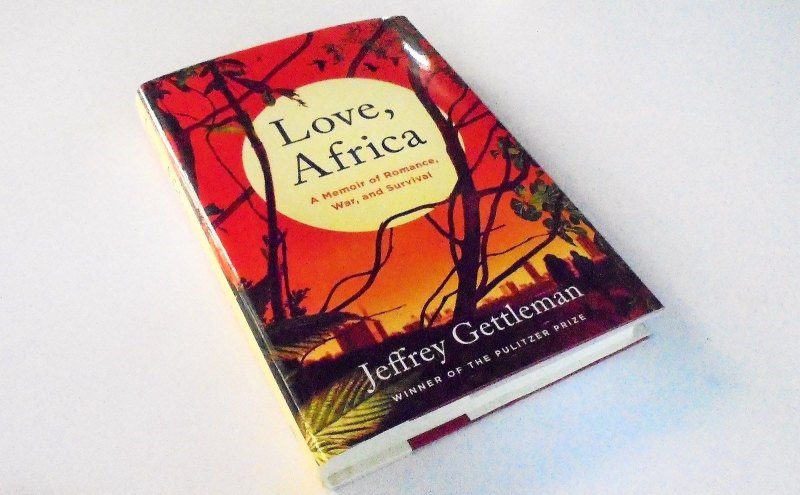
Jeffrey Gettleman’s Love, Africa is not just a memoir; it’s a raw, electrical current that crackles between two loves: a woman and a continent.
In this vivid tale of ambition, affection and sheer survival, Gettleman charts a journey from a wide-eyed idealist to a Pulitzer Prize-winning correspondent based in Nairobi, weaving a tapestry that is as intoxicating as it is unsettling. With each page, readers are dragged into the dust and drama of far-flung war zones, into the tender strangeness of long-distance romance, and into the uncharted terrain of a man torn between home and the wild places that define him.
From the start, Love, Africa reads like a coming-of-age epic for a generation defined by conflict and contradiction. At 19, Gettleman plunges into East Africa on a community service trip that imprints upon him “the spirit, the energy, the differences, the feel” of a land that will never let him go. Simultaneously, he falls headlong for Courtenay, a brilliant and principled fellow student whose brilliance matches, and often outshines, his own restless charm. What unfolds is an almost mythic tension: the tug of an extraordinary love on one side, and the irresistible gravity of a continent on the other.
Gettleman’s prose is anything but distant. He has the keen eye of a reporter and the heart of a romantic, and the fusion makes for magnetic storytelling. He captures Africa’s landscapes with tangible texture, from the hot, shimmering savannah to the terrifying front lines of insurgency, and does not flinch from the beauty and brutality that coexist in the world’s most conflicted places. His voice is immediate and personable, drawing you into moments both spectacular and mundane, whether it’s a harrowing encounter with pirates or the quiet ache of waiting for a phone call from someone you love.
It helps that Gettleman peppers his narration with prose that stays with you. Consider his reflection: “It’s easy to explain why you like something. But love? That’s tricky. That’s a story, not a sentence.” This line wrestles with love’s ineffability, a theme that is at once personal and universal. And then there’s his wry yet gloomy insight: “You can have it all, just not at the same time.”
These lines are not mere flourishes; they are the emotional bedrock of a book about impossible choices and the cost of pursuing passion.
Readers who come for the romance will find themselves caught up in the feverish push and pull between Gettleman and Courtenay, a relationship strained by distance, danger and the kind of youthful impulsiveness only time can temper. Readers who come for the adventure will find themselves in battle zones from Iraq to Somalia, alongside a narrator whose curiosity is matched only by his willingness to risk life and limb for a story. And at every turn, Africa pulses as character as much as backdrop, shaping Gettleman as surely as any person could.
Yet for all its strengths, Love, Africa is not without flaw. One of the book’s most persistent criticisms, and a fair one, is that its focus sometimes drifts so wholly into the internal experience of the author that the continent itself can feel secondary, or worse, a stage for his personal drama. While Gettleman’s passion for Africa is palpable, the narrative does not consistently invite authentic African voices to share the spotlight, instead re-centring the Western observer’s perspective. This can give the memoir, at times, a sense of self-absorption that undermines the richness and complexity of the world it depicts. It’s a poignant memoir, yes, but it can feel like one man’s journey about Africa, rather than a book that truly opens its arms to the many stories on the continent itself.
In the end, Love, Africa is a voyage into the heart’s wild places. Don’t pick it up expecting a conventional travelogue or a straight biography. Pick it up because you want to understand how our greatest loves, whether for a person, a place or a calling, reshape the very core of who we are. For better and for worse, Jeffrey Gettleman delivers a story that refuses to be confined to a single genre or emotion, just as the Africa he fell for refuses to be reduced to a simple story at all.