
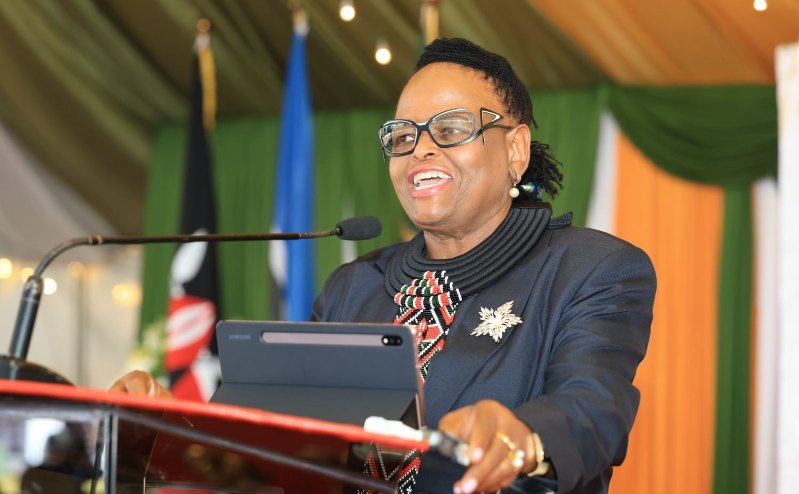
 Chief Justice Martha Koome/HANDOUT
Embu County has emerged as the latest focal point in Kenya’s expanding Alternative Justice System (AJS) framework.
This follows the official launch of a regional AJS Centre and supporting registries at Embu Law Courts, signalling a continued shift by the Judiciary towards decentralised and people-centred justice delivery.
The rollout was spearheaded by Chief Justice Martha Koome during the opening of the 4th National Conference on Alternative Justice Systems held at the University of Embu on Thursday.
It marked a notable step in embedding restorative and community-based dispute resolution mechanisms within the formal justice architecture.
The new Embu AJS Centre, alongside registries established in Siakago and Runyenjes Law Courts, is expected to strengthen access to justice by offering residents structured avenues for mediation, reconciliation, and community dialogue, reducing reliance on lengthy court processes.
Chief Justice Koome said the expansion of AJS reflects a broader judicial philosophy that goes beyond traditional performance indicators such as case clearance rates and backlog reduction.
Instead, she urged African judiciaries to adopt a more holistic understanding of justice outcomes that captures lived experiences of citizens.
“Traditionally, justice systems have relied on indicators such as case filings, clearance rates, backlog reduction, and speed of case resolution. These measures remain important. However, they do not always capture the full experience of justice from the perspective of the people we serve,” she said.
Koome emphasised that justice must increasingly be measured by its social impact, including reconciliation, trust building, and restoration of dignity.
She noted that the integration of formal courts, Alternative Dispute Resolution (ADR), and AJS reflects a deliberate move towards a unified justice ecosystem.
“In doing so, we affirm that the rule of law in Africa must be accessible, inclusive, culturally grounded, gender-responsive, and capable of delivering not only decisions, but also healing and lasting peace,” she added.
The Chief Justice further described Alternative Justice Systems as a core expression of African jurisprudence rooted in community wisdom and the principle of Ubuntu, noting that elders and community structures have long played a central role in resolving disputes and maintaining social cohesion.
The Embu launch is aimed at bringing justice services closer to the community, particularly in rural and peri-urban areas where access to formal courts can be constrained by distance, cost, and procedural complexity.
Deputy Chief Justice Philomena Mwilu called for stronger collaboration between the Judiciary, county governments, civil society, academia, and development partners to ensure the success of AJS implementation.
She stressed that data-driven reforms and continuous learning would be critical in shaping effective justice delivery systems.
“It will require better data, rigorous evaluation and a willingness to learn from both our successes and our shortcomings. Most importantly, it will require us to keep justice seekers at the centre of every reform,” Mwilu said.
The conference also drew participation from visiting African Chief Justices, including Zambia’s Chief Justice Dr Mumba Malila, who urged judiciaries across the continent to fully embrace Alternative Dispute Resolution mechanisms as a way of widening access to justice and strengthening social cohesion.
Malila noted that a “multi-door courthouse” approach, which integrates litigation, mediation, and community-based resolution systems, can ease pressure on courts while promoting economic efficiency by resolving disputes faster.
With Embu now part of Kenya’s expanding AJS network, the Judiciary continues to position Alternative Justice Systems as a central pillar in the country’s justice transformation agenda.