
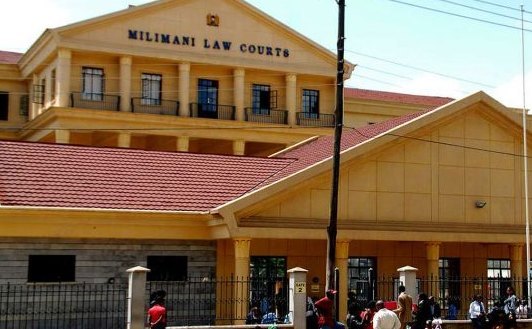
 Milimani Law Court/FILE
The ongoing trial of former Chase Bank officials has placed audit evidence at the centre of proceedings as the defence mounted a sustained challenge to Deloitte audit reports relied upon by investigators.
Questions over the credibility, scope and interpretation of the audit findings took centre stage, with the defence arguing that the reports do not directly establish criminal liability.
During cross-examination before the trial court, defence lawyer Cecil Miller pressed the prosecution witness, Allo, on the reliability of Deloitte’s audit work, its regulatory history, and the conclusions contained in reports forming part of the prosecution’s evidence.
Miller questioned whether the audit process met the threshold of independence expected in forensic investigations, pointing to previous regulatory scrutiny of the audit firm in other financial sector cases.
“You are aware that Deloitte has previously been investigated in relation to audits of institutions such as CMC Motors, Mumias Sugar and Dubai Bank?” Miller put it to the witness.
The witness acknowledged awareness of past scrutiny involving the firm but maintained that this did not automatically invalidate its work in the present matter.
The defence further highlighted sanctions imposed by the Capital Markets Authority (CMA), including a Sh10 million fine against Deloitte over its audit of Chase Bank for failing to detect errors in financial statements presented for audit.
The witness confirmed the sanction but rejected the suggestion that it amounted to proof of wrongdoing contributing to the bank’s collapse.
Miller also challenged the dual role of Deloitte in both statutory audit and subsequent forensic review after Chase Bank was placed under receivership, suggesting a possible conflict of interest.
“I put it to you that Deloitte’s involvement in both the audit and forensic review created a conflict of interest,” the lawyer stated.
The witness disagreed, insisting that internal separation ensured independence.
“No, there was no conflict. These were done by different teams, different offices and different assignments,” Allo testified.
An exchange arose when Miller questioned whether forensic findings were influenced by earlier audit work.
The witness maintained there was no overlap affecting independence.
The court also heard that Deloitte’s reports did not directly implicate the second accused, Dan Kang’a Buyu, in criminal activity.
Miller further suggested that forensic experts involved in related investigations took several years before finalising their report, including teams based in South Africa.
“I put it to you that the forensic team in South Africa took not less than five years before being compelled to sign the report,” Miller said.
The witness, however, distanced himself from that line of inquiry.
“I was not involved in that assignment. I have no information on that,” he replied.
The defence argued that the audit reports, while central to the prosecution case, did not directly attribute criminal conduct to the accused persons and should therefore be treated with caution.
Chase Bank Kenya collapsed and was placed under receivership by the Central Bank of Kenya in April 2016.
Several former officials were later arrested and arraigned in court.
The trial resumes on August 4, 5 and 11, 2026.