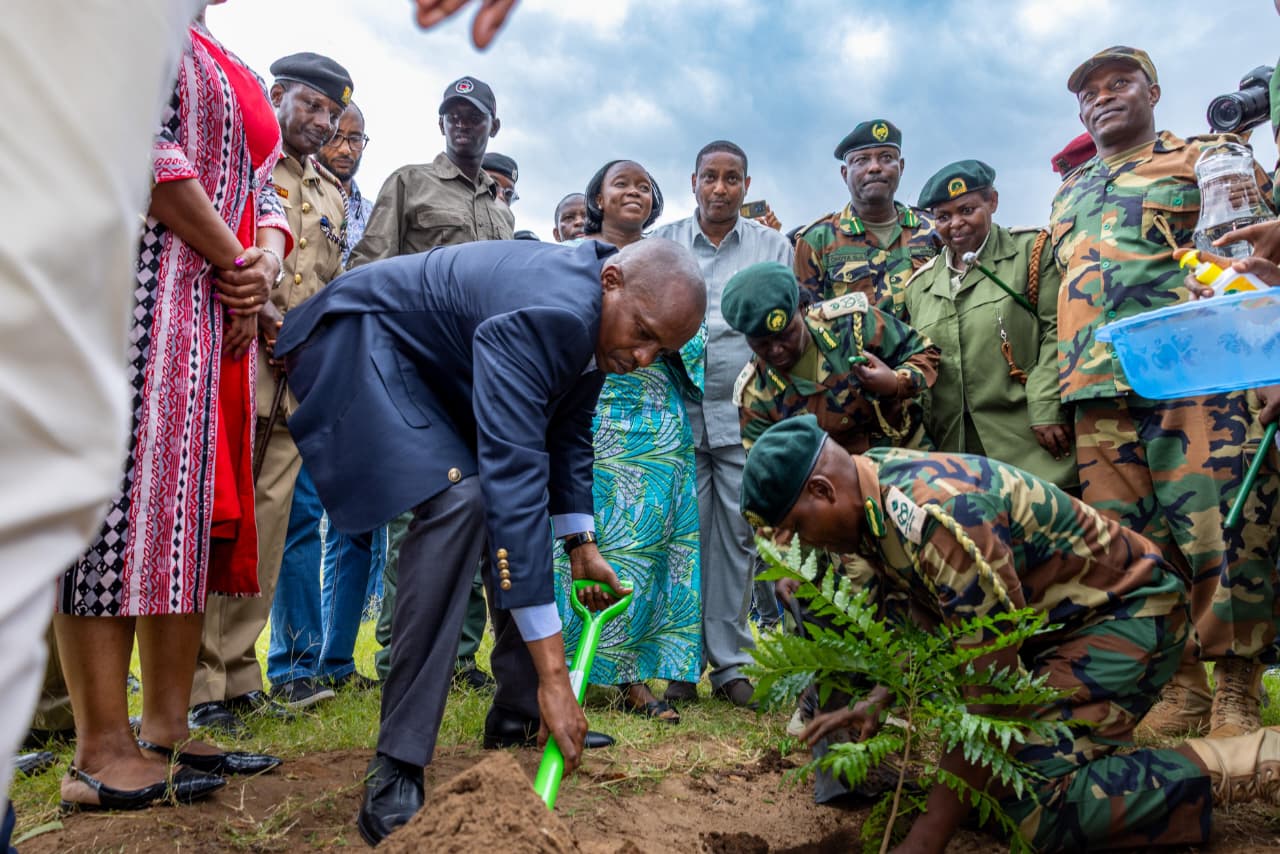

 H.E. Gideon Behar, Ambassador of Israel to Kenya, Tanzania, Uganda, Malawi & Seychelles; Permanent Representative to UNEP & UN-Habitat./HANDOUT
As the world marks World Environment Day under the theme “Inspired by Nature". For Climate. For Our Future,” I find myself thinking less about climate conferences and more about the lessons nature has quietly been teaching us all along.
In my previous capacity as Israel’s Special Envoy for Climate Change and Sustainability, I participated in global negotiations on emissions, adaptation, financing, and resilience. Those conversations remain essential. But over time, I came to understand something even deeper: nature solved many problems long before humanity complicated them.
A forest wastes nothing. Wetlands naturally purify water. Bees sustain food systems through pollination. Mangroves protect coastlines from storms more effectively than many artificial barriers. Nature survives through balance, regeneration, adaptation, and cooperation. Perhaps this is why the climate crisis today is not only an environmental crisis but increasingly a crisis of human behavior.
For decades, humanity has consumed more than the planet can regenerate. We have treated forests as disposable, rivers as dumping grounds, wildlife habitats as expansion zones, and the atmosphere as limitless. Yet our economies, food systems, health, water security, and livelihoods all depend directly on nature remaining healthy. Without healthy ecosystems, there is no sustainable future.
In both Israel and Kenya, climate change is no longer theoretical. It is visible in prolonged droughts, devastating floods, failed harvests, disappearing biodiversity, rising food insecurity, and growing pressure on water systems. Farmers increasingly struggle with unpredictable seasons. Communities face mounting uncertainty. The poorest and most vulnerable often suffer first and most severely. Yet despite these challenges, I remain optimistic. Not because the crisis is small, but because I have seen what becomes possible when innovation works together with nature instead of against it.
Israel is a country where more than 60 percent of the land is desert. Scarcity forced us to innovate. We learned that every drop of water matters. Today, Israel recycles nearly 96 percent of its wastewater for agriculture, the highest rate in the world. Drip irrigation, first developed in Israel, was inspired by observing how nature delivers water slowly and efficiently through plant roots. Climate-smart agriculture, desalination technologies, precision farming, and renewable energy solutions all emerged from one reality: survival depends on adaptation.
But technology alone will never be enough. Some of the most powerful environmental solutions are found not in laboratories, but within communities themselves. I have seen this transformation firsthand. I have met farmers in Kibwezi using precision irrigation systems that allow them to grow more food while using less water. I have visited demonstration farms in Kajiado where climate-smart agricultural techniques are helping communities adapt to changing weather patterns and prolonged droughts. These experiences remind me that environmental cooperation becomes most meaningful when it improves everyday lives.
This is the spirit the world must now scale up. Environmental conservation can no longer remain separate from agriculture, infrastructure, energy, or urban development. Protecting ecosystems is essential for economic stability, public health, food security, and long-term peace.
This means investing seriously in reforestation, landscape restoration, protecting watersheds, rehabilitation of degraded ecosystems, and rebuilding the natural systems that communities depend upon. Kenya’s goal of planting 15 billion trees by 2030 reflects the growing recognition that restoring nature is not only an environmental responsibility, but also an investment in climate resilience, water security, economic sustainability, and future generations.
Additionally, this also means expanding and strengthening protected natural areas while creating ecological corridors that allow wildlife and ecosystems to recover and adapt to climate pressures. Nature cannot survive in isolated pockets surrounded by environmental destruction. We must also rethink how we produce food. Sustainable and eco-friendly farming practices can reduce environmental degradation while improving long-term agricultural productivity. Reducing excessive chemical use, improving soil conservation, protecting pollinators, harvesting rainwater, and supporting regenerative agriculture are no longer idealistic concepts. They are practical necessities.
Equally important is changing everyday human behavior. Climate action is not only the responsibility of governments. It is reflected in how we consume, how we dispose of waste, how we use water and energy, how cities are designed, and how businesses measure success. Small choices, when multiplied across millions of people, create enormous impact. The climate conversation often focuses on catastrophe. We hear constantly about what humanity is losing. And indeed, the warnings are serious. But we must also speak more about what humanity can still build.
A greener future is not merely about sacrifice. It is also about opportunity. The transition to renewable energy can create jobs. Sustainable agriculture can improve food security. Cleaner cities can reduce disease and improve public health. Nature restoration can strengthen resilience against floods and droughts. Environmental cooperation can deepen regional partnerships and peace. In many ways, climate change is forcing humanity to rediscover something ancient: our survival is interconnected. No country can solve this crisis alone because we share one atmosphere, one ecosystem, and ultimately, one future.
Israel and Kenya already cooperate in areas such as water management, agriculture, renewable energy, innovation, health and environmental resilience. These partnerships are not merely technical exchanges but are investments in human dignity and future generations. And perhaps this is the true meaning of this year’s theme. To be “inspired by nature” is not simply to admire landscapes or protect wildlife occasionally. It is to fundamentally rethink how we live, produce, consume, build, and coexist with the environment around us. Nature teaches resilience. Nature teaches efficiency. Nature teaches cooperation. Nature teaches regeneration. Humanity must now do the same.
As we mark World Environment Day, I hope we move beyond seeing environmental action as an obligation driven by fear. Instead, we should embrace it as an opportunity to build wiser societies, healthier economies, greener cities, and a more secure future for generations to come. Because ultimately, climate action is about protecting the possibility of human dignity, stability, and hope for our children and grandchildren.
The writer is the Ambassador of Israel to Kenya, Tanzania, Uganda, Malawi & Seychelles; Permanent Representative to UNEP & UN-Habitat