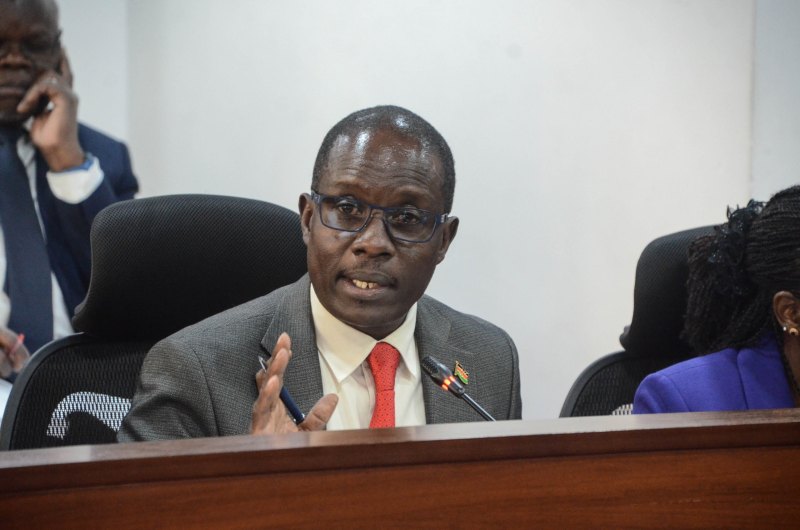
 Livestock Development PS Jonathan Mueke unveils the National Agri-food Systems Investment Plan (NASIP) 2026–2030 during the 2026 Financing Agrifood Systems (FINAS) Summit at KICC. /HANDOUT.
The government has launched an ambitious Sh1.081 trillion investment plan aimed at transforming the country’s agricultural sector, improving food security, and attracting billions of shillings in private capital over the next five years.
The National Agri-food Systems Investment Plan (NASIP) 2026–2030 was unveiled during the 2026 Financing Agrifood Systems (FINAS) Summit being held in Nairobi
Speaking during the launch, Livestock Development Principal Secretary Jonathan Mueke said the NASIP is expected to guide investments across crops, livestock, fisheries, irrigation, agro-processing, digital agriculture, climate resilience, research and agricultural finance.
"NASIP is a Sh1.081 trillion national investment framework that will guide Kenya's agri-food systems transformation over the next five years. It will serve as our invitation to investors and partners to join us in building a more food-secure, resilient and prosperous nation," said Mueke.
The investment plan comes at a time when African countries are grappling with climate change, rising food demand, volatile global markets and limited financing for agriculture.
Although Africa possesses nearly 60 per cent of the world's remaining uncultivated arable land, the continent remains a net food importer, highlighting the urgent need for increased investment in agricultural production and value addition.
Mueke said Kenya has shifted its approach by positioning agriculture as an investable economic sector rather than relying solely on government funding.
"We recognise that public resources alone cannot finance agricultural transformation. Government must therefore play a different role, not as the sole financier, but as an enabler of investment, a manager of risk and a trusted partner in creating the conditions for sustainable private capital to flourish," he said.
The PS said that out of the Sh1.081 trillion, the national and county governments are expected to contribute 35 per cent of the funding, while the private sector will provide 45 per cent. Development partners and bilateral donors will finance the remaining 20 per cent.
According to Mueke, the investment will support irrigation expansion, modern agricultural value chains, climate-smart farming, food security initiatives and improved access to agricultural finance. It is also expected to create more than two million jobs while increasing farmers' incomes.
Mueke said the investment plan complements the recently launched AgriConnect Compact, Kenya's national commitment under the Comprehensive Africa Agriculture Development Programme (CAADP) Kampala Declaration.
He added that NASIP will translate those commitments into a fully costed investment framework that aligns government, county governments, development partners and private investors under one implementation plan.
"This investment is not simply about financing agriculture. It is about financing Kenya's future. It is about building resilient food systems, modernising agricultural value chains, creating jobs and positioning Kenya as a competitive regional hub for sustainable agrifood investment," he said.
The government also used the summit to rally investors, commercial banks and development finance institutions to finance bankable agricultural projects identified under NASIP.
Germany reaffirmed its support for Kenya's agricultural transformation during the summit.
Head of Development Cooperation at the German Embassy, Maren Kneller, said Germany has already invested more than Sh31.8 billion (€215 million) in Kenya's agri-food sector, benefiting about 1.1 million farmers through programmes that improve productivity, expand irrigation, create jobs for young people and support agricultural reforms.
She announced an additional Sh4.62 billion (€31.2 million) in funding agreed during bilateral talks in Berlin last week.
The package includes Sh444 million (€3 million) for agricultural value chains and private sector partnerships, Sh918 million (€6.2 million) to improve export readiness and trade, and Sh3.26 billion (€22 million) for irrigation infrastructure in western Kenya.
"Partnership is increasingly shifting from traditional donor support to mobilising private sector investment and public-private partnerships that promote jobs, value chain development and climate-resilient agriculture," she said.
FINAS Summit Director Charity Mutegi said African countries must rethink how agricultural financing is structured if they are to unlock the sector's full potential.
"We cannot continue financing food systems the same way and expect different results. The focus now must be on creating financing models that attract investment, reduce risk and turn policy commitments into action," she said.
Mutegi noted that one of the summit's biggest achievements was the launch of NASIP, describing Kenya as one of the first African countries to develop a comprehensive national investment instrument aligned to the continental CAADP framework.
She said the summit would also focus on strengthening public-private partnerships, improving the policy environment and connecting investors with bankable agricultural opportunities capable of accelerating the country's food systems transformation.