

![[PHOTOS] Maize harvest begins at Galana Kulalu](/_next/image?url=https%3A%2F%2Fcdn.radioafrica.digital%2Fimage%2F2025%2F10%2Fa3a0d88a-aa19-442a-9445-cce75126c4bf.jpg&w=3840&q=100)
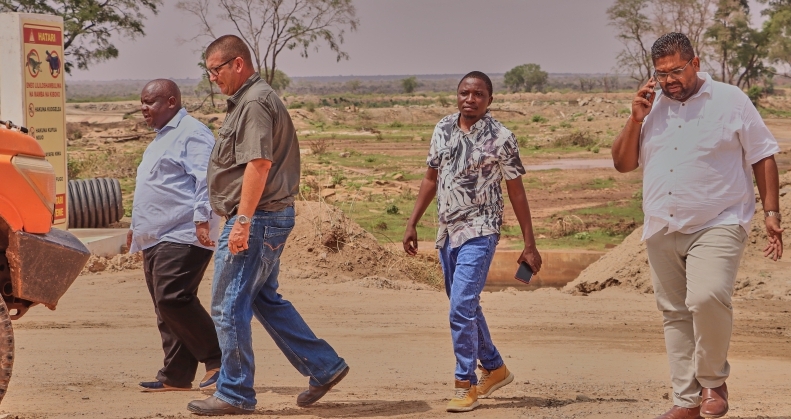
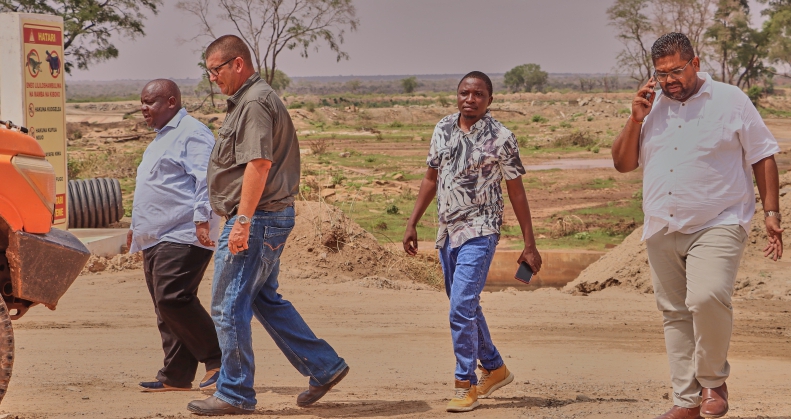 Nyumba Farm agri engineer Phillip Manwa, farm manager Jaco Coertze, irrigation manager Jonathan Yeri and assistant farm manager Pravin Kerai at the farm on November 29 - FELIX KIPKEMOI
Just after sunrise, when the Galana River lies still and the air is briefly cool, the scale of the transformation becomes clear.
A 105km drive northwest of Malindi takes you inside a landscape that, until recently, was known more for its rugged emptiness than for any promise of abundance.
What was once a wilderness with scattered acacia, cracked soil and empty horizons two years ago is slowly emerging as a food-production hub anchored by engineering, irrigation and relentless investment.
At first glance, the landscape looks like a mirage, an endless sweep of dun-coloured plains that for decades defined the unforgiving heart of Galana-Kulalu.
The sun bites sharply at mid-morning, shimmer rising over the flat horizon.
Yet just a few kilometres deeper into the private section of the vast government-owned agricultural block, the scene begins to shift.
Newly dug canals cut across the plain, dams rise from the ground and giant centre pivots turn steadily over young crops, tracing the outline of a farm system intent on rewriting Galana-Kulalu’s long, difficult story.
A moment later, a green arc appears, then another. Long, rotating metal arms glide across fields of onion, maize and cassava, drawing fresh life into a place once written off as barren wilderness.
At one other end is a tractor rumbling through the fields, dragging a harrow that smooths the soil for the next round of planting.
Nyumba Farm, spearheaded by the Nyumba Foundation with capital support from Mombasa Cement, is now one of the most ambitious commercial farming operations in the region.
The farm is an evolving goldmine carved out of harsh land using water, engineering and stubborn determination. Inside it, the transformation feels almost improbable.
“We started this project in 2023 with the help of President William Ruto and his advice,” Nyumba Foundation director Kirtan Kanji says. “He asked us to explore this opportunity."
Their main goal was to "create a better place than it was, improve the soil using water from the river, create employment and produce enough food to lower costs and reduce importation”.
The foundation is now harvesting onions on a scale the Coast region has never seen, helping push down retail prices that historically remained high due to reliance on imports.
But that outcome is only a small piece of the vast vision unfolding here.
BIRTH OF A MEGA FARM
Galana-Kulalu, spanning 1.8 million acres, has long been at the centre of Kenya’s push to commercialise land and reduce food deficits.
Yet for decades, most of it remained dormant, hindered by water scarcity, poor soils, uncertainty and political drama.
The Nyumba Foundation, leasing 300,000 acres through the Agricultural Development Corporation, is among the private investors finally turning policy ambitions into visible outcomes.
It borders the government’s PPP Selu-run farm, forming part of a growing belt of irrigated land.
In two years, the foundation has injected more than $50 million (Sh6.4billion), equivalent to about Sh5 million every day over that period.
“We began with infrastructure,” he says.
These include dams, canals, roads, power systems and pivots.
"Today we have almost 10 million cubic metres of water stored for irrigation. We have installed 23 pivots already, each covering 123 acres,” he says.
That amounts to 2,830 acres of irrigation infrastructure, though only 766 acres are currently under crop, a deliberate, careful ramp-up as soils improve and new pivots come online.
The real miracle lies not in the crops but in the engineering that makes them possible.
Engineer Peter Waigwa, who has overseen much of the infrastructure design, says extensive surveys and soil testing were conducted before work began.
Feasibility work got underway in early 2023, with teams of specialists surveying the land, studying the local ecology and mapping wildlife corridors, including centuries-old elephant paths, to ensure the project integrated smoothly with the nearby Tsavo ecosystem.
A thorough analysis of the Galana River soon followed, forming the foundation for the irrigation blueprint.
By March 2023, more than a hundred machines had arrived on site, beginning large-scale land preparation and engineering operations.
Remarkably, the entire irrigation system requires just one per cent of the Galana River’s water.
Water from the river is diverted into the main canal, and the entire system operates using gravity.
A 17km canal feeds 14 large dams, with newer dams, including the massive Dam 15, pushing storage capacity even higher. This canal acts as the farm’s main artery.
“Once the water gets into the first dam,” Waigwa says, “gravity helps us move it from one dam to the next. It reduces pumping costs and allows us to irrigate continuously.”
A smart weather station complements the system, collecting real-time data on rainfall, wind speed, humidity and evapotranspiration to guide irrigation and disease forecasting.
Heavy infrastructure for roads and power lines now cuts across the land, while large solar installations help reduce dependence on the unreliable grid.
“We are currently building the 15th dam,” farm manager Jaco Coertze says.
“It will hold four million cubic metres alone. It will take two to three months to fill, by March 2026.
SOIL HEADACHE
Even with the engineering muscle in place, the harsh soil remains one of the greatest challenges.
Assistant farm manager Javier Masai, a specialist in soil chemistry, explains that the soil’s high pH locks nutrients, making crop growth difficult.
"It’s a challenging environment,” he says.
“We use gypsum to correct it, and we plant rotational crops and cover crops to heal the soil slowly.”
Improvement will take four to five years, but the team is already seeing results.
The first crops were selected strategically: Seed maize for its high value, onions for quick returns, cassava for resilience and rotational crops for soil restoration.
“We currently have 766 acres under cultivation,” agronomist and operations manager Eric Kimathi says.
He says 469 acres are under seed maize, 43 under cassava and 296 under onions. Out of the onion block, 49 acres are already being harvested.
Despite the vastness of the operation, the farm is surprisingly quiet. Machines dominate.
“Operations are 90 per cent mechanised,” Kimathi says.
Still, the human footprint is significant. During infrastructure construction, Kanji says nearly 3,000 workers were on site.
Today, the farm employs 600 staff and engages up to 600 local workers, depending on needs.
Locals support operations through weeding, sorting, packing, dam construction and security.
The foundation has also supported nearby villages and trading centres with painted houses and school food donations.
“The community is part of the project,” Coertze says. “If we succeed, the region succeeds.”
WATER, WILDLIFE AND SURVIVAL
Water remains the farm’s lifeline.
“We work in a very challenging environment,” irrigation manager Jonathan Yeri says, “because it rains once a year. Without dams, nothing is possible.” Wildlife, especially elephants, presents another challenge.
The farm uses sisal as a buffer crop to deter animals and is planning a 35,000-acre wildlife conservation area to balance food production with environmental stewardship.
Before the operations began, Coertze says Nyumba Foundation teams visited Malawi and Sudan, countries with deep experience in irrigation farming. The lessons were sobering but valuable.
“If you want to succeed, you must keep pushing,” he says.
The insights shaped Nyumba’s decisions on mechanisation, crop selection and soil rehabilitation.
Despite having 766 acres currently under crop, the long-term vision is far greater.
“By the end of 2027,” Coertze says, “we expect to have all 300,000 acres under plantation.”
Expansion will involve hundreds more pivots, expanded water storage, increased mechanisation, continued soil correction and the introduction of edible oil crops, such as sunflower, simsim, castor, coconut and palm.
During a recent meeting, Agriculture CS Mutahi Kagwe addressed the doubts surrounding Galana-Kulalu.
“There is a lot of scepticism,” he said, adding that private sector capital is essential.
"The role of the private sector must be enhanced. We must find ways for government to facilitate and regulate, not do everything alone."
Nyumba Farm has become the clearest demonstration of what private investment, paired with government support, can achieve.
It offers proof that commercial agriculture can thrive in arid zones, that soil can be revived with science and patience, and that technology can turn harsh plains into productive land.
Crucially, it shows that Galana-Kulalu is not a doomed desert but a frontier waiting to be unlocked.
As the sun leans westward, workers sort freshly harvested onions under a makeshift shade, a tractor rumbles by with stacked crates, and excavators mould Dam 15 in the distance.
Standing at the edge of a maize block, Kanji surveys the land that was once wild bush.
“The success for me,” he says quietly, “is to produce maximum food to feed the country. And most importantly, to help the local community and inspire more Kenyans to be involved in such modern farming.”
Galana-Kulalu is no longer an idea.
It is a living, growing reality, an evolving green belt in a place once dismissed as impossible.
Here in the middle of Kilifi’s harsh plains, a private investor is proving that with water, technology and resolve, even a jungle can become a goldmine.