
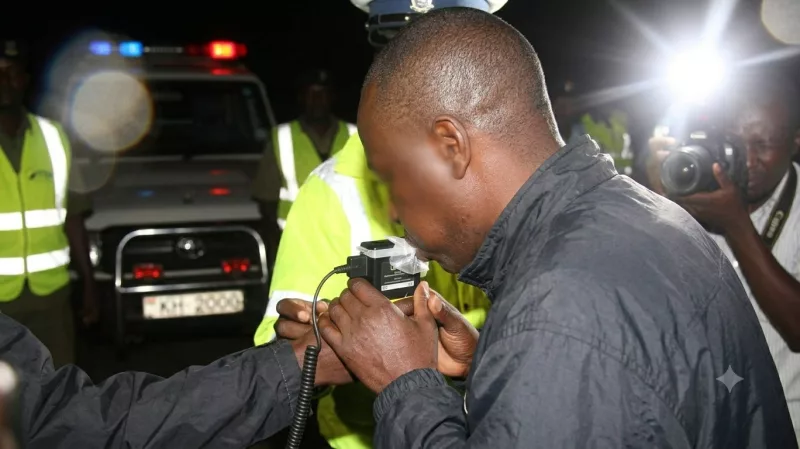
 A motorist using the alcoblow kit./AI ILLUSTRATION
The National Transport and Safety Authority (NTSA) has announced an intensified alcoblow crackdown and road safety enforcement campaign across the Coast region as schools close for the August holidays.
In a statement on Monday, the Authority said its Mombasa Regional Office, in collaboration with the County Government of Mombasa and the National Police Service (NPS).
The agencies have launched road safety sensitisation campaigns at major bus parks to promote safer travel during the busy holiday period.
According to NTSA, the operation will combine public awareness sessions for drivers and passengers with heightened drink-driving (alcoblow) enforcement and stricter compliance checks along major highways.
"The campaign includes awareness sessions for drivers and passengers, intensified drink-driving (alcoblow) enforcement, and enhanced road safety compliance operations along major highways to promote safer travel during the holiday period," the Authority said.
The Authority also urged passengers to play an active role in preventing road crashes by speaking out whenever they witness dangerous driving.
NTSA advised travellers to remain vigilant and immediately raise the alarm if a driver is speeding, appears intoxicated, is fatigued, uses a mobile phone while driving, overtakes dangerously, drives on the wrong side of the road, fails to maintain lane discipline or engages in any other form of distracted driving.
The Authority further appealed to members of the public to support the campaign by reporting unsafe practices that could endanger children and other road users during the school holiday travel period.
An alcoblow, officially known as a breathalyser, is a device used by police for measuring the amount of alcohol in a driver's breath.
The reintroduction of Alcoblow on Kenyan roads has been part of broader efforts to curb road accidents attributed to drunk driving. For instance, in November 2023, the National Police Service announced plans to deploy Alcoblow breathalyzers on major highways ahead of the festive season, aiming to deter motorists from driving under the influence.
How does it work?
Alcoblow can function in two modes: active and passive. In active mode, the driver directly blows into the device, allowing for precise measurement of alcohol levels.
This versatility facilitates rapid screening of multiple individuals, making it particularly effective during roadside checks.
The breathalyzer works by using an electrochemical fuel cell sensor to detect and measure alcohol in exhaled breath, offering both active and passive modes for quick alcohol screening.
Active is where the subject blows into the device, while passive is where the device draws a sample of breath from the air around the subject when one is not able to directly blow into the breathalyzer.
Once the subject has blown into it, the device displays the results, typically using colored lights and/or beeps to indicate the presence or absence of alcohol.
The fuel cell reacts with the alcohol, and there is an electrical discharge that takes place from the fuel cell.
There is also a direct proportion depending on the amount of alcohol that is on the breath sample to how much electricity will come out.
According to the Office of Science and Society at McGill University, breath analyzers contain an anode (negatively charged electrode) and a cathode (positively charged electrode).
When you blow into a breathalyzer, the ethanol in your breath reacts with water from the air at the anode and is oxidized to form acetic acid (like in vinegar).
There are a few situations in which a breathalyzer may fail to measure accurately.