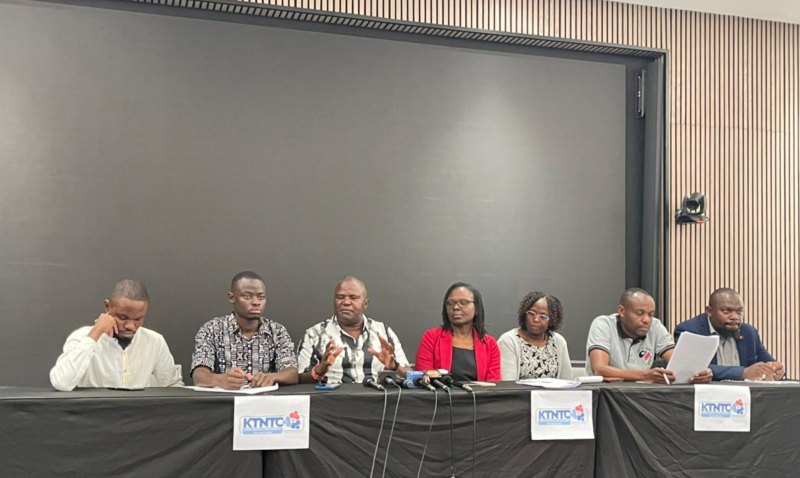

 Government Pathologist Dr Johansen Oduor addressing the media after the examination on June 16, 2026/ SCREENGRAB
Postmortem examinations on bodies recovered from shallow graves in Mwingi, Kitui County, have revealed signs of violent deaths, including strangulation, blunt force trauma and stabbing, deepening the mystery surrounding the grisly discovery.
Government pathologist Johansen Oduor conducted the autopsies on Tuesday after the remains were transferred from Kitui to Nairobi for examination.
The bodies were recovered earlier this month in Mwingi town near Kasina Primary School, where residents discovered human remains protruding from a shallow grave on June 9.
Speaking to journalists after the examinations, Oduor said the remains were significantly decomposed, making it difficult to determine the exact cause of death in some cases.
“Our final analysis of the bodies, they were decomposed significantly, all of them, some with parts of the body becoming skeletalised,” he said.
Although seven bodies had initially been reported, pathologists treated the remains as eight separate cases because one of the bodies had a detached head.
“So, in summary, we treated them as eight bodies because one had a detached head, which had been cut separately,” Oduor said.
The examinations established that two of the victims had been strangled.
“One of them could find the ligature mark there on the neck, but the other one had just the mark of strangulation,” he said.
The postmortem also found that one victim had suffered a penetrating injury in the form of a stab wound to the abdomen, while three others sustained head injuries consistent with blunt force trauma.
“Three of them actually had a head injury. There were some signs of blunt trauma to the head,” Oduor said.
However, the pathologists were unable to determine the cause of death for two of the bodies because of the advanced state of decomposition.
“Two, we were unable to ascertain the cause of death because of decomposition,” he said.
According to the pathologist, several of the deaths may have resulted from violence, although investigators have yet to establish the identities of the victims or the circumstances surrounding their deaths.
Asked whether the injuries pointed to intentional acts, Oduor said strangulation and stabbing are generally associated with deliberate actions.
“You cannot strangle yourself. You can only hang yourself, but this was strangulation,” he said.
According to the pathologist, the varying levels of decomposition made it difficult to determine precisely how long the bodies had been buried, although preliminary estimates suggest they may have been dead for up to three months.
“From the casual look, I can say the last three months,” Oduor said.
Samples have been collected for DNA analysis and toxicological tests to help identify the victims and determine whether toxins played a role in any of the deaths.
“Because nobody has come up to claim these bodies, we usually treat them as unknown,” Oduor said.
He urged families of missing persons to provide samples for DNA matching to assist in identifying the victims.
The bodies are expected to be returned to Mwingi after the autopsy process and preserved pending identification.
Oduor dismissed claims that the bodies had been preserved using formalin before recovery, saying the level of decomposition indicated otherwise.
“Looking at those bodies, there’s no arrest of decomposition, so none of them had preservatives put on them,” he said.