
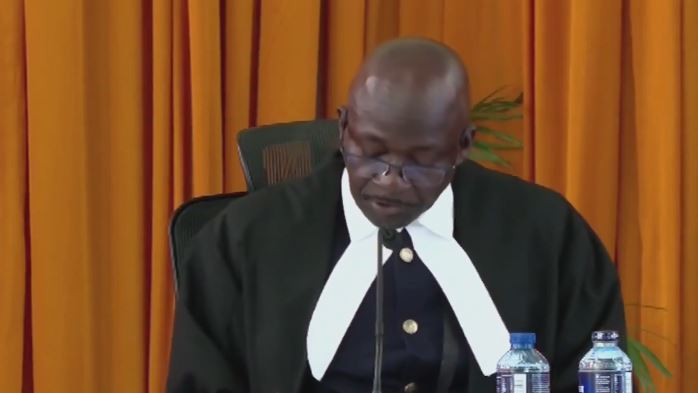
 High Court Judge Eric Ogola./SCREENGRAB
The High Court has found no evidence to support allegations of bias, predetermination or conflict of interest in the impeachment proceedings against former Deputy President Rigathi Gachagua.
In dismissing the claims, Justice Eric Ogola, delivering the judgment on behalf of a three-judge bench held that political participation and expression of views by legislators cannot, on their own, amount to constitutional bias.
"The mere fact that members supported or opposed the impeachment of His Excellency Gachagua cannot, standing alone, establish constitutional bias," the court stated.
The judge emphasised that impeachment is an inherently political-constitutional process in which lawmakers are not expected to approach proceedings without prior knowledge or political opinion
"Legislators are not expected to approach impeachment as blank slates, devoid of political opinion or prior knowledge," Ogola noted.
What is required under the Constitution, the court said, is not the absence of political inclination but the presence of good faith engagement with evidence and arguments during the process.
"What the Constitution requires is that they remain genuinely open to considering the evidence, listening to argument, and discharging their constitutional responsibilities in good faith and within constitutional limits," the judge said.
On that basis, the court rejected the petitioners’ allegations that lawmakers had predetermined the outcome or were influenced by conflict of interest, finding that such claims were not supported by material evidence.
"We therefore find that the allegations of bias, predetermination and conflict of interest advanced by the petitioners against the Speakers, Members of Parliament and Senators are, on the material before this Court, no more than bare and unsubstantiated assertions grounded in political inference and suspicion rather than in objective evidence," Justice Ogola ruled.
The court underscored that constitutional standards cannot be lowered to require absolute neutrality in thought or political affiliation among elected representatives engaged in impeachment proceedings. Instead, the legal threshold is whether the process allowed fair consideration of evidence and whether decision-makers acted within constitutional bounds.
In addressing the broader constitutional framework, the bench further held that impeachment proceedings are justiciable and subject to judicial scrutiny where constitutional violations are alleged.
"We find that the impeachment proceedings challenged in these petitions are justiciable, and that this Court possesses jurisdiction under Articles 23, 22 and 165 of the Constitution to determine whether the National Assembly and the Senate acted within constitutional bounds," Ogola stated.
However, the court clarified the limits of its mandate, stressing that it does not sit as a political body to determine the merits or sufficiency of impeachment charges.
"We reiterate that the Court is not a political arbiter but a constitutional one," the judge said.
Justice Ogola added that while courts may review the legality of the process, they cannot substitute Parliament’s political judgment with their own assessment of the seriousness of allegations.
"We agree in principle with the submission that it is not the function of this Court to determine whether the charges against His Excellency Gachagua were of sufficient gravity to warrant his removal from office," he observed.
The court further reaffirmed that separation of powers must be understood in harmony with constitutional accountability, not as a barrier to judicial oversight.
"The separation of powers does not mean separation from the Constitution," Ogola concluded, reinforcing the judiciary’s role in safeguarding constitutional compliance while respecting the institutional roles of Parliament.