

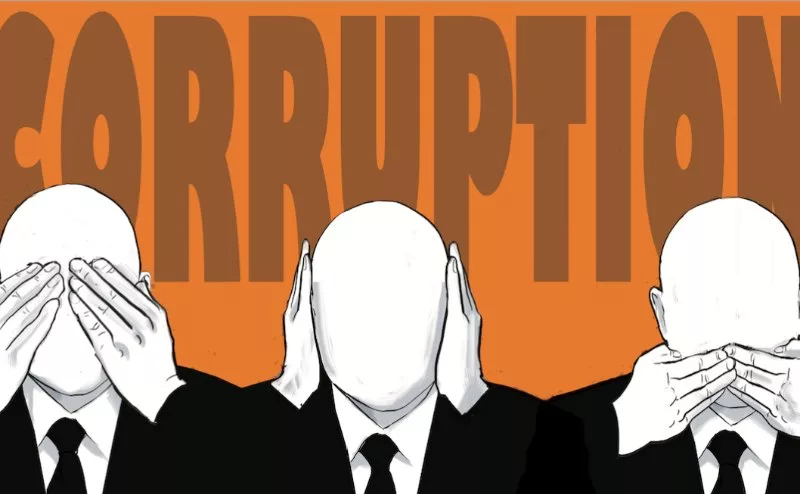
Last week, Africa marked African Anti-Corruption Day, established by the African Union to commemorate the adoption of the AU Convention on Preventing and Combating Corruption (AUCPCC).
The day is a continental call to integrity, transparency, accountability and ethical governance — a recognition that corruption drains public resources, corrodes justice systems and destroys citizens' trust in institutions. For Kenya, it should be less a commemoration than a moment of reckoning.
The 2024 National Ethics and Corruption Survey paints a grim picture of daily life in this country. Citizens are routinely forced to grease palms to access basic public services — a practice so normalised that most victims no longer bother to report it.
Although average bribe amounts have declined, the vice remains deeply entrenched. This is not merely a statistic; it is a mirror held up to a nation, reflecting how far corruption has seeped into our institutions, our governance and our everyday social interactions.
The rot takes many forms, from petty extortion at service counters to the grand theft of public resources. It manifests in inflated procurement deals, nepotistic hiring, ghost projects and elite cartels that siphon billions from the national purse. The cost is staggering.
Kenya loses an estimated Sh608 billion annually to graft — roughly seven per cent of GDP. That sum could pay the salaries of more than 250,000 graduates entering the job market every year. Little wonder the World Bank warns that corruption is among the greatest threats to eradicating poverty and achieving shared prosperity.
Nor is this a new affliction; every administration since Independence has bequeathed its own mega-scandal. The Moi era gave us Goldenberg, in which billions were siphoned from the Central Bank through fictitious gold and diamond export compensation, and the grossly inflated Turkwel Gorge dam.
President Kibaki, despite riding to power on an anti-graft ticket, presided over the Anglo Leasing phantom security contracts and the Triton oil scandal that cost banks and taxpayers Sh7.6 billion.
The Kenyatta years brought the NYS heists, where billions flowed to ghost suppliers, and the Arror and Kimwarer dams fiasco, in which some Sh20 billion was paid out for dams that were never built.
And under the current administration, the fake fertiliser scandal has threatened food security while the Sh443 million KNH oxygen plant tender has yielded a non-functional facility.
The names change; the script does not. Graft persists not only because of greedy leaders, but because it has been normalised at every level of society — from homes where children are bribed with sweets, to schools where grades are bought, to offices where merit is replaced by connections.
The consequences are corrosive. More than half of Kenyans are disillusioned with the country's direction, convinced that corruption has become a national pandemic. Worse still, those implicated too often simply buy their way out. The courts are meant to be channels through which justice flows without hindrance; instead, justice has frequently gone to the highest bidder.
Evidence is distorted in exchange for money or lost through negligence, and high-profile cases collapse under weak charges or political interference — resulting in zero prosecutions and turning the Judiciary into another battlefield in the very war it should be arbitrating.
The rate at which corruption continues to sink this nation demands immediate remedies — nothing short of a complete overhaul of systems and structures. That overhaul must begin by depoliticising the fight. Anti-graft agencies must be empowered, not weaponised. Politicians must stop dismissing prosecutions as "witch-hunts" the moment their allies are implicated.
And we must exert sustained public pressure on the Judiciary and the police to act willingly and without favour, so that evidence is preserved, charges are watertight and culprits face justice. Those in the dock must learn that justice cannot be bought forever.
Here, the media and the wider communication industry deserve applause — and reinforcement. Social media and investigative journalism have become among the greatest forces for change, exposing the crooks milking public coffers. We must support this watchdog role, protect whistleblowers and deploy technology to track every shilling of public spending.
The lessons from abroad are instructive: in the 1960s, Singapore's economy was at par with Kenya's, yet today it ranks among the least corrupt nations on earth, thanks to tough laws, impartial adjudication, relentless enforcement and a clean public administration — all held together by the unwavering political will of Lee Kuan Yew's leadership. Hong Kong, South Korea and Taiwan tell a similar story: transparency, digital accountability and professional oversight can dismantle even the most entrenched cartels.
But laws and systems alone will not save us. We must have the courage to admit that we have lost our way through an erosion of morals and ethics. What Kenya needs is a mind-shift transformation — beginning with how we perceive wealth creation itself.
No nation can overcome corruption amid conflicting values. Through holistic education, minds can be refined and cleared of the thinking that breeds social evil. Our schools, universities and places of worship must become sanctuaries of ethics, not breeding grounds for shortcuts. And character must become the gauge for leadership: a person of questionable lifestyle must never stand out as fit to lead.
The youth must be at the forefront of this transformation. The next generation is supposed to spearhead honesty and accountability, yet the exchange of money for the heart of the nation has blinded many young leaders and incapacitated their efforts to join Kenyans of goodwill. Reclaiming them for the cause of integrity is not optional; it is where the battle will be won or lost.
This is where the Ruto administration faces its defining test. It has an opportunity to reset the nation's moral compass — to reward integrity, dismantle patronage networks and inspire a culture in which public office is a duty, not a gateway to wealth. But history warns that promises are not enough. Successive governments have vowed to fight graft, only to shield allies implicated in mega-scandals. To end corruption nationally, we need more action and less talking.
Corruption is not only a crime; it is a betrayal of the future. It steals medicine from hospitals, books from students and dignity from citizens. Ultimately, it is ordinary Kenyans — from market vendors to professionals, and above all the youth — who will determine whether corruption remains our fate or becomes our past.
As the continent pauses to reflect this African Anti-Corruption Day, Kenya's choice is stark. We can defeat corruption — but only if we choose courage over silence, justice over loyalty, and the future over fear.
Mandela Washington Fellow and governance-leadership analyst | [email protected]

![[PHOTOS] Elderly brave cold to vote in Ol Kalou](https://cdn.radioafrica.digital/image/2026/07/d2345b9e-578f-45ff-9bb0-d7819671c165.webp)

![[PHOTOS] Ol Kalou residents turn out in large numbers to vote](https://cdn.radioafrica.digital/image/2026/07/fe42d51c-7f79-466e-94e8-59561f77bbe7.webp)