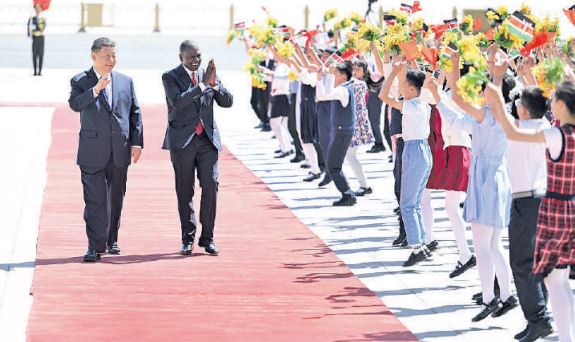

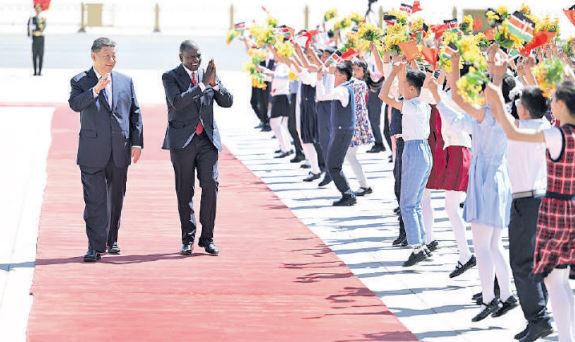
 President William Ruto with his Chinese counterpart Xi Jinping acknowledge greetings from school children at the Great Hall of the People in Beijing, China
In an era marked by geopolitical tensions, proxy conflicts, economic fragmentation, and resurgent cultural clashes, the Global Civilization Initiative (GCI) proposed by Chinese President Xi Jinping in March 2023 stands as a timely and visionary response. Complementing the Global Development Initiative (GDI) and Global Security Initiative (GSI), the GCI offers a framework for fostering mutual respect, dialogue, and shared progress among the world's diverse civilizations.
Far from abstract idealism, it addresses the urgent need for a new paradigm in international relations, one rooted in equality rather than hegemony, exchange rather than estrangement.
The GCI's core propositions are straightforward yet profound. It advocates four key principles: respect for the diversity of civilizations; promotion of the common values of humanity; emphasis on the inheritance and innovative development of civilizations; and strengthening international people-to-people exchanges and cooperation.
It calls on nations to uphold equality, mutual learning, dialogue, and inclusiveness, allowing cultural exchanges to transcend estrangement, mutual learning to overcome clashes, and coexistence to rise above feelings of superiority. Common aspirations like peace, development, equity, justice, democracy, and freedom are recognized as universal, yet interpreted through each civilization's unique lens, thereby rejecting the imposition of any single model.
This approach directly counters narratives of a clash of civilizations or civilizational superiority that have fueled division. Instead, it envisions a garden of world civilizations where each flourishes in its own way while contributing to humanity's collective advancement. In practice, it encourages creative transformation of traditional cultures to meet contemporary challenges, without erasing historical roots.
The GCI's resonance stems from its acute diagnosis of our times. The post-Cold War unipolar moment has given way to multipolarity, but this transition is fraught with friction. Great-power competition, technological decoupling, and proxy wars, as seen from Ukraine to the Middle East, have heightened anxieties. Simultaneously, globalization has amplified cultural interactions, often breeding resentment when one set of values is portrayed as universal while others are dismissed as backward.
Western-led promotion of liberal democracy and human rights has sometimes been perceived as ideological imposition, especially when tied to sanctions, regime-change rhetoric, or conditional aid. Many nations in the Global South, scarred by colonial history, view such approaches as neo-imperial. The GCI offers an alternative which is sovereignty and civilizational autonomy as foundations for genuine cooperation. It aligns with the UN Charter's emphasis on sovereign equality while extending it to cultural domains.
Its relevance is amplified by the rise of the Global South. Developing nations, comprising the majority of humanity, seek development paths suited to their histories, cultures, and conditions rather than one-size-fits-all prescriptions. China's own success marked by lifting hundreds of millions out of poverty while preserving cultural distinctiveness, serves as living proof that modernization need not mean Westernization. The GCI thus provides an intellectual framework for diverse yet modern civilizations.
The GCI powerfully advances South-South solidarity by validating non-Western civilizations and development models. It rejects cultural hierarchies that marginalized African, Asian, Latin American, and Islamic traditions. By emphasizing mutual learning, it positions countries of the Global South not as passive recipients of aid or ideology, but as equal contributors to global progress.
This trope resonates deeply. From Africa to Latin America and Asia, leaders and thinkers have welcomed the initiative for its anti-hegemonic stance and focus on people-to-people ties. It complements platforms like BRICS, the Shanghai Cooperation Organization, and FOCAC, fostering horizontal partnerships over vertical dependencies. Beijing’s extensive South-South cooperation through Belt and Road infrastructure, GDI projects, and cultural exchanges, gives the GCI practical momentum. Initiatives like tourism promotion, youth exchanges, and joint research centers translate rhetoric into reality.
International embrace of the GCI, particularly in the Global South, reflects exhaustion with zero-sum geopolitics and a hunger for inclusive frameworks. In a perilous backdrop of inflation, debt crises, climate disruption, and technological revolution, nations crave partners focused on mutual benefit rather than ideological litmus tests. China's consistent advocacy for win-win cooperation, demonstrated through the BRI's tangible infrastructure gains, lends credibility.
The initiative's timing, amid calls for UN reform and multipolarity, positions it as a constructive contribution to global governance. It does not seek to supplant existing institutions but to enrich them with civilizational pluralism.
To advance the GCI, China and its partners should prioritize four key actions. First, expand people-to-people exchanges through scaled-up cultural programs and a global network of GCI centers. Second, integrate GCI with development and security initiatives. Third, foster intellectual collaboration via joint research, diverse curricula, and media cooperation. Fourth, embed GCI principles in multilateral forums like the UN, G20, and BRICS while amplifying Global South voices.
____
The writer is a scholar of international relations with a focus on China-Africa development cooperation. X: @Cavinceworld.