
The story of modern China is often told through skyscrapers, high-speed rail, and semiconductor factories.
Yet, the nation’s most radical achievement is not found in its cities, but in its fields.
Over the last few decades, Beijing has engineered an agricultural transformation that defies its geographic constraints.
China possesses just seven per cent of the world’s arable land and six per cent of its freshwater, yet it successfully feeds 1.4 billion people—nearly one-fifth of the global population.
This is not an accident of nature; it is the result of a deliberate, heavily funded, and highly strategic state effort that treats food security as a core pillar of national sovereignty.
For China, food security is synonymous with regime stability and national security. The leadership’s historical memory is deeply shaped by past famines and an acute awareness of geopolitical vulnerabilities.
If China relies on the West or volatile global markets for its staple crops, it exposes its underbelly to foreign pressure.
Consequently, the central government has funnelled trillions of yuan into a modern agricultural revolution, shifting the nation away from subsistence farming and into an era of high-tech agrarian industrialisation.
The backbone of this strategy is the radical upgrading of agricultural infrastructure. For centuries, Chinese farming was defined by small, fragmented plots worked by ageing peasants with manual tools.
Recognising that this model could not sustain an urbanising superpower, China embarked on a massive land consolidation program.
The state invested heavily in creating “high-standard farmland”—vast tracts of unified land equipped with advanced irrigation systems, drought-resistant soil structures, and automated water-saving technologies.
These fields are engineered to guarantee stable yields even in the face of severe weather anomalies, which have become increasingly frequent due to climate change.
Simultaneously, China has positioned itself at the cutting edge of agricultural science, specifically in seed technology.
Government policy explicitly designates seeds as the “microchips” of agriculture. To break dependency on foreign seed giants, Beijing has built massive state-of-the-art gene banks and poured subsidies into domestic biotechnology firms.
The results are evident in the widespread adoption of high-yield, climate-resilient crop varieties.
From seawater-tolerant “sea rice” grown in saline-alkali soils to advanced gene-edited corn and soybeans, Chinese labs are rewriting the biological limits of crop production to squeeze maximum nutrition out of every square inch of available dirt.
Technology on the ground has evolved just as rapidly. Walk into a modern farm in Heilongjiang or Xinjiang, and you are more likely to see a drone operator than a labourer with a hoe. China’s tech sector has seamlessly integrated with its agricultural goals.
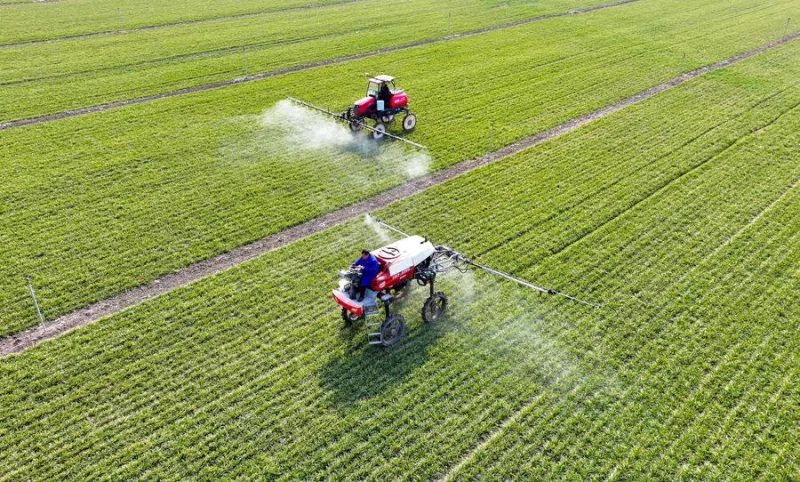
Autonomous tractors guided by the Beidou satellite navigation system plough fields with millimetre precision.
Drones spray fertilisers and pesticides across millions of hectares, reducing waste and chemical runoff.
In southern provinces, multi-story “pig skyscrapers”—vertical, biosecure, automated livestock facilities—have replaced traditional farms to maximise meat production while insulating herd populations from devastating diseases like African swine fever.
However, China’s agricultural triumph is not without its internal contradictions and steep environmental costs. Decades of pushing for maximum output led to the systemic overuse of chemical fertilisers and plastics, causing widespread soil acidification and groundwater pollution.
The current administration has had to pivot toward “green agriculture,” investing billions more to remediate damaged soils, enforce crop rotation, and incentivise organic fertilisers.
Balancing the absolute mandate for high yields with the urgent need for ecological restoration remains a delicate tightrope walk for policymakers.
Furthermore, despite achieving near 100 per cent self-sufficiency in staples like rice and wheat, China's changing dietary habits present a moving target.
As hundreds of millions of citizens entered the middle class, consumption of meat, dairy, and processed foods skyrocketed.
This dietary shift created an insatiable domestic demand for animal feed, making China the world's largest importer of soybeans.
To mitigate this vulnerability, the state is aggressively investing in alternative proteins, synthetic biology, and diversifying its global supply chains through the Belt and Road Initiative, purchasing farmland and port infrastructure abroad.
Ultimately, China’s agricultural journey offers a powerful lesson in state-directed development.
It proves that a nation does not have to be blessed with boundless natural resources to achieve food independence.
Through sustained capital investment, a relentless focus on technological innovation, and an unwavering political will, China has turned a potential existential vulnerability into a showcase of state capacity.
In an era defined by geopolitical friction, supply chain disruptions, and climate chaos, China’s ability to keep its dinner bowls firmly in its own hands is perhaps its greatest geopolitical shield.
The lesson from Beijing is clear: feeding a nation in the 21st century requires treating the humble farm field with the same strategic gravity as the high-tech military laboratory.
The writer is a commentator on International matters




![[PHOTOS] Elderly brave cold to vote in Ol Kalou](https://cdn.radioafrica.digital/image/2026/07/d2345b9e-578f-45ff-9bb0-d7819671c165.webp)


![[PHOTOS] Ol Kalou residents turn out in large numbers to vote](https://cdn.radioafrica.digital/image/2026/07/fe42d51c-7f79-466e-94e8-59561f77bbe7.webp)