
 SCREENGRAB/BBC
The man accused of shooting Charlie Kirk at a college last year strolled around its campus, ate a meal at Chick-fil-A and interacted with the conservative activist's staff before he allegedly killed him, a court has heard.
Tyler Robinson, 23, also returned close to the Utah Valley University crime scene afterwards and briefly interacted with an officer, an investigator testified.
Details of Robinson's alleged movements were shared on the second day of a hearing that will test if the evidence is strong enough to proceed to trial.
Robinson has not entered a plea, but throughout the hearing, his lawyers have disputed much of the evidence and expert testimony.
Robinson is accused of fatally shooting Kirk as he addressed an audience at the campus on 10 September 2025
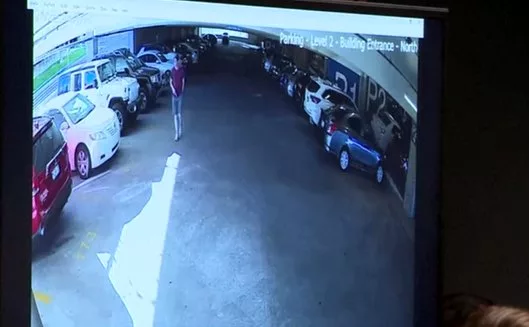
The hearing included new footage that shows a man, who prosecutors say is Robinson, repeatedly on campus on the day of the killing.
The video also appears to show the suspect jumping off the roof while holding an object.
David Hull, Utah's state Bureau of Investigation lead investigator on the case, testified about the footage and Robinson's alleged movements that day.
He took the court through surveillance footage that allegedly showed Robinson on campus about four hours before the attack, strolling around the college in a T-shirt and shorts and buying a meal at Chick-fil-A.
Hull testified that Robinson was seen approaching members of Kirk's Turning Point USA organisation, but did not elaborate on the interaction.
Hull testified that Robinson allegedly left and returned to the campus - about 90 minutes before the attack.
When he reappeared on campus, the suspect was wearing different clothes and seemingly walking with a limp, according to Hull.
Footage allegedly showed the suspect making his way to the Losee Building on the campus and rolling over a railing on to the rooftop.
Shortly after the fatal shot rang out, the same man can be seen running across the roof, dropping down with an unknown object in his hands and making his way off campus, Hull testified.
A rifle was later recovered "in the wooded area where we believe Mr Robinson entered the wooded area", Hull told the court.
Hours after the attack, Robinson allegedly returned to the school, Hull testified.
He told the court that an officer briefly interacted with Robinson near the campus while a manhunt was underway in the early hours of 11 September.
Hull testified that Robinson had tried to drive a grey Dodge Challenger on to campus, but drove off after a police officer briefly spoke with him.
The officer noted Robinson's vehicle licence plate.
Robinson's defence team, led by attorney Kathy Nester, has sought to exclude much of the evidence and argued to have the death penalty taken off the table.
Nester spent much of Tuesday aiming to discredit key pieces of evidence being displayed by prosecutors.
Under questioning from Nester on Tuesday, Hull acknowledged that at least one other weapon had been found on campus on the day of the shooting.
Hull also said no shell casings were discovered on the rooftop near a suspected "sniper pad" - an impression in gravel discovered by another officer which appeared to indicate where a shooter was lying down with a direct line of sight to where Kirk had been speaking.
Nester also told the court some witnesses had described a different suspect on the rooftop, while a few others interviewed by police had claimed a bald man had been driving the vehicle alleged to be Robinson's in security footage shown on Monday.
Robinson's defence team objected repeatedly to evidence and testimony during the first two days of the preliminary hearing.
They argued that footage had been edited, and pointed out that those who had originally filmed the footage were not on the stand and not able to be questioned.
Their repeated objections, calling into question key pieces of evidence, have helped shed light on their potential defence strategy, which has remained a mystery since Robinson's arrest.
Following Hull's testimony, the prosecution called Jennifer Faumuina, a sergeant with the state bureau of investigation, who testified about how investigators processed DNA found on a screwdriver, rifle and towel recovered after the shooting.
Prosecutors then introduced an FBI report which found that the DNA matched Robinson, as well as his roommate and romantic partner, Lance Twiggs, who has co-operated with police.
The defence also called its first witness, FBI forensic analyst Amanda Bakker, who signed the DNA report - questioning her at length about protocol and the potential for interpretation or error in testing.
After the hearing - which is due to end on Friday - Judge Graf will not make a determination of guilt or innocence, but will weigh whether the prosecution has presented strong enough evidence for the case to proceed to trial.
The hearing almost resembles a trial but prosecutors have a low bar to meet, as they just need to demonstrate there are reasonable grounds that Robinson should be tried before a jury.
At a typical US trial, prosecutors need to prove a guilt "beyond a reasonable doubt".