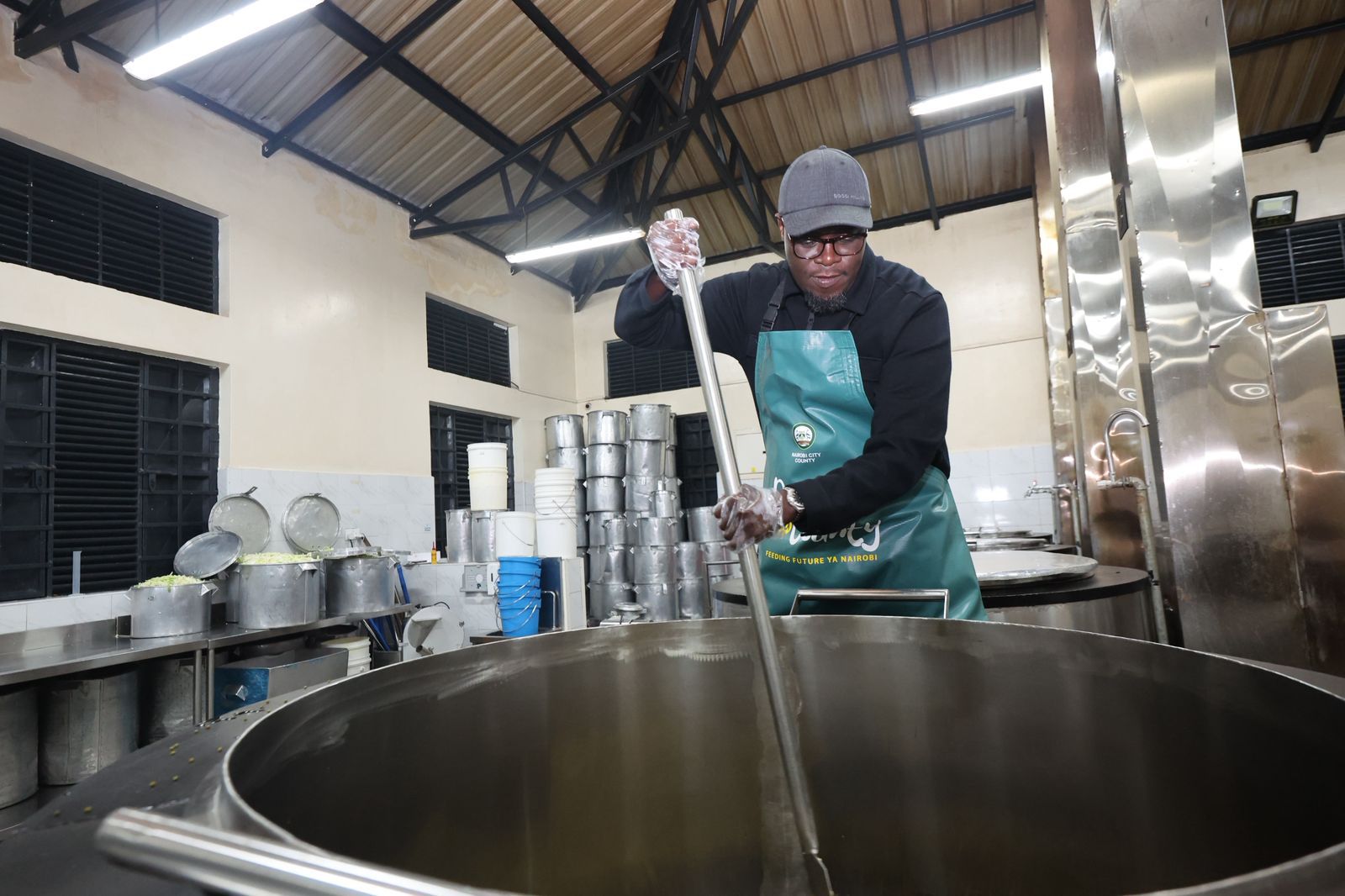

A school feeding programme in Murang’a county is doing more than providing meals to schoolchildren. It is creating jobs, supporting small businesses and generating income for local residents who supply goods and services linked to the initiative.
On a dusty quarry in Kimunyu village, Murang’a county, Jesse Moses, popularly known as Jessy, oversees the sourcing of sand for construction projects. What began as a modest venture selling sand by wheelbarrow has grown into a thriving business supplying established contractors and organisations.
Today, Jessy is among local entrepreneurs whose livelihoods have been boosted by activities connected to a school feeding programme, demonstrating how investments in children's nutrition can also stimulate economic opportunities in communities.
“Before, it was all about how many wheelbarrows of sand we could excavate and move in a single day. I had hired two labourers to dig alongside me, and we would spend long hours under the sun, shovelling and loading sand. Sometimes, after all that work, I would only get paid after two days,” he says.
Everything changed in 2016, when Jessy was asked to supply sand directly to a contractor building a modern kitchen for a nonprofit organisation on the outskirts of Murang’a town.
“That was the turning point,” he says, looking back with nostalgia. “Instead of supplying brokers, I was now supplying directly to a company constructing a modern kitchen that would feed young learners in public primary schools.”
Years later, Jessy has no regrets about his decision to focus on construction materials such as sand, while many of his peers moved to Nairobi in search of white-collar jobs that never materialised.
Today, the Form 4 leaver has built a legacy as a contractor running his own company and overseeing the construction of some of the organisation’s modern kitchens across the country.
From a casual labourer to the owner of a fully fledged construction company, Jessy now directly employs dozens of workers through his firm, including some of his former classmates.
His company is among the businesses supplying directly to Food4Education, a Kenyan nonprofit that has been feeding more than 635,000 learners daily across the country since 2012.
“Today, I have more than 40 employees who are motivated and determined because we have a calling,” he says.
GAMBLE PAYS OFF
For Charles Kamau, a supplier of vegetables and fruits, his partnership with Food4Education came at one of the most difficult economic periods in recent history.
He joined the programme in February 2023, when many businesses were still struggling from the aftershocks of the Covid-19 pandemic. At the time, he had a lorry full of cabbages from Murang’a and uncertain prospects for buyers.
Then came a call from Food4Education, requesting 600 kilograms of cabbage, just as he was about to offload his lorry in Ruiru Town.
“I chose Food4Education and lost my other clients,” he says of leaving his long-term customers stranded as he decided to feed the learners at their expense.
However, for Kamau, this was a gamble that would later change everything, including his fortunes.
Today, Kamau directly employs 73 people and supports more than 400 others indirectly through his supply chain. His business now works with 126 small-scale farmers owning less than an acre of land, alongside nine large-scale farmers.
“Last year, we supplied 360 tonnes of cabbage,” he says. “We rarely sleep, but we are proud to be associated with Food4Education and the amazing work they are doing to feed the future.”
Jessy’s and Kamau’s gambles years back to venture into the supply business with Food4Education has paid off handsomely.
At scale, the organisation is not only creating opportunities for small-scale vendors but also generating jobs, supporting local enterprises and stimulating economic activity across communities in Kenya.
They are among more than 300 artisans, transporters, manufacturers and food vendors who recently gathered in Nairobi for a capacity-building workshop hosted by Food4Education.
The session stressed the far-reaching impact of school feeding programmes, an impact measured not only in the number of meals served but also in the businesses and livelihoods built from the ground up.
For Jessy, the journey evolved from supplying construction materials for the organisation’s early kitchens to becoming part of its food supply ecosystem. As Food4Education expanded its network of centralised kitchens, Jessy expanded with it.
“I joined Food4Education from scratch as a supplier of sand to now being a contractor,” he says. “I started with a wheelbarrow, then a pickup, then a lorry.”
GENDER INCLUSIVE
In Tetu, Nyeri county, Mary Nduta, a vegetable vendor, is one of the women supplying directly to Food4Education. She stands as a testament to the transformation driven by the school feeding programme.
Nduta remembers delivering just 96 kilos of tomatoes during her early days with the programme. Today, she supplies nearly 800 kilos of tomatoes to Food4Education’s programme.
“Food4Education has brought us a long way,” she says. “We are here today because of them. Where you get your daily bread is where you invest.”
Nduta says women suppliers and vendors are as many as their male counterparts, reflecting the organisation’s broader commitment to women’s economic empowerment.
“I am very happy with the way the organisation has been treating us. Fifty per cent of the suppliers are women, and within the organisation, up to 70 per cent of the staff are women. This is an organisation that cares for us women,” she says.
Nduta is now working with some 10 women who help her pick and collect vegetables from farms before loading them for supply to the Food4Education kitchens for the school feeding programmes.
“I pay them every two weeks when I receive payment. They are happy because that is where they get their money to feed their families,’’ she says.
“Many people have asked me why we have more women staff, but the answer is that when I started this programme, women were more willing to work with me than men. Given that much of the work involved cooking, some men were not interested in taking it up,” she says.
For artisans like Peter Njuguna, the organisation became a catalyst for innovation, skills transfer and business growth.
In 2018, Njuguna received an order to supply 80 food containers. Shortly afterwards, the request increased to 200.
“I did not believe it because I had never made those containers before,” he says with a laugh.
The orders kept growing. From 200 containers, he eventually manufactured more than 3,000 as the school feeding programme expanded across the country.
To keep up with demand, he trained additional workers, transforming a one-man operation into a business employing tens of workers.
“Today, I have trained 20 people who work with me to make the containers,” he says. “As Food4Education grew, I also grew.”
His work now takes him as far as Mombasa and Kakamega for maintenance and repair assignments, opportunities he says would never have existed without the partnership.
“I have learnt that for me to progress, I need to innovate and move with the organisation,” he says.
GROWTH AND AMBITIONS
In the second half of 2025, Food4Education procured 703 metric tonnes of cabbage, 221 metric tonnes of carrots, and more than 2.1 million bananas, figures that demonstrate the scale at which school feeding can stimulate local agricultural markets and strengthen rural economies.
Wawira says sustainability has remained central to the organisation’s growth strategy.
“We have donors, government and parents supporting the programme to ensure sustainability,” she said during the suppliers’ workshop. “We do a lot in terms of cash flow management and planning to ensure sustainability.”
Over the past 15 months, the organisation has delivered 20,874 tonnes of food ingredients and 10.8 million fruits, with about 80 per cent of its food sourced from local smallholder farmers.
From a single kitchen in Ruiru serving 25 children in 2012, the organisation has expanded to more than 180 kitchens across Kenya.
Food4Education chief operating officer Nyawira Nyandia says the programme intends to expand into five additional counties in the next 18 months as it works towards serving one million meals daily by the end of 2027.
“What you are doing is not just for Food4Education but also for your country as well. As Food4Education expands, that means more opportunities for our vendors created by demand,” she said during the vendors’ workshop recently, adding that the organisation is now eyeing even bigger ambitions.
By sourcing food, transport, construction materials and other services locally, programmes such as Food4Education create steady markets for small businesses, stimulate rural economies and support job creation across the supply chain.
Economists argue that beyond improving learning outcomes and nutrition, school feeding programmes inject money directly into local economies, helping families and enterprises grow sustainably.
“School feeding programmes have one of the highest social and economic returns on investment because the benefits ripple across entire communities,” says economist and development policy analyst David Kariuki.
“When food and services are sourced locally, the programmes strengthen small businesses, create jobs and increase household incomes, while at the same time improving children’s education and nutrition outcomes.”
As governments and development agencies around the world search for sustainable solutions to hunger, Food4Education’s model is increasingly demonstrating that school feeding programmes can do more than nourish children.
They can create jobs, build enterprises, strengthen local agriculture, empower women and artisans and spark entire economic ecosystems.
Today, Jessy no longer pushes wheelbarrows across dusty construction sites. Instead, he stands overseeing teams of workers as modern kitchens rise from the ground, some on the very same sites where he once supplied sand as a struggling labourer.
The impact is deeply personal, yet it mirrors the scale at which school feeding programmes are transforming livelihoods, empowering communities and shaping the future of a generation.
“These people believed in me, and I also believed in them,” he says.
Now employing more than 40 workers through his construction company, Jessy’s journey, from hauling sand in Murang’a to building kitchens that feed thousands of learners, stands as a powerful reminder that the fight against hunger often begins not just with a plate of food but also with an opportunity that changes lives.











![[PHOTOS] Calm prevails in Kisumu, Homa Bay](https://cdn.radioafrica.digital/image/2026/06/dff8923b-c99a-4f40-a4be-cc996653e4e0.jpg)