
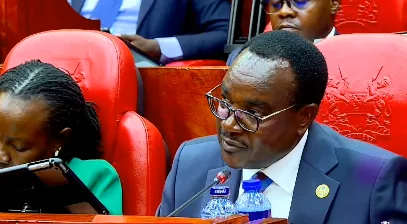
 Education Cabinet Secretary Julius Ogamba speaking before the National Assembly Public Investments Committee on Governance and Education (PIC-GE) on July 15, 2026/ SCREENGRAB
Education Cabinet Secretary Julius Ogamba has attributed persistent delays in capitation to universities, Technical and Vocational Education and Training (TVET) institutions and teacher training colleges to funding shortfalls from the National Treasury.
Ogamba said the ministry rarely receives the full amount it requests each financial year, resulting in annual funding gaps that have strained tertiary institutions.
Appearing before the National Assembly Public Investments Committee on Governance and Education (PIC-GE) on Wednesday, the CS said the funding challenges had affected the operations of institutions across the country.
"The challenge has been that whatever amount we request, because of financial constraints, we do not receive the full allocation. That creates annual deficits, except in the 2025/26 financial year where TVET capitation was fully disbursed as budgeted," Ogamba told the committee.
The CS appeared before the committee alongside Higher Education Principal Secretary Beatrice Inyangala, TVET Principal Secretary Esther Thaara Muoria, Universities Fund acting chief executive Edwin Wanyonyi and Higher Education Loans Board (HELB) chief executive Geoffrey Monari.
The officials were responding to Auditor-General's reports covering the 2018/19 to 2024/25 financial years, which highlighted delayed capitation, stalled infrastructure projects, weak financial management, declining enrolment in some TVET institutions, underutilised government equipment and growing financial challenges in public institutions.
During the session, lawmakers raised concerns over the impact of delayed funding on learning institutions, with some saying declining enrolment and rising debts were affecting the sustainability of public colleges and universities.
Kilome MP Thaddeus Nzambia said enrolment in several TVET institutions had dropped significantly, with some colleges admitting less than half the number of students they previously had.
"The principals consistently point to delayed capitation as the major reason students are dropping out. This was a good programme meant to equip young people with technical skills, but the current trend is worrying," he said.
Embakasi West MP Mark Mwenje questioned why institutions continued to experience financial difficulties despite repeated assurances that capitation funds had been released.
He also cited the growing funding gap facing public universities, saying many students were increasingly relying on Constituency Development Fund bursaries and HELB loans to continue with their studies.
Ogamba said the ministry was working with the National Treasury to secure more predictable funding and had submitted additional budget requests to address financing gaps affecting the education sector.
He said the State Department for Higher Education and the Universities Fund were engaging the Treasury on institutions' funding requirements and cash flow needs to facilitate timely release of approved allocations.
The CS said the government was also pursuing long-term reforms through the proposed Tertiary Education Funding Bill, 2025, which seeks to establish a sustainable financing framework by consolidating tertiary education funding into a single pool for equitable distribution.
Addressing concerns over stalled development projects, Ogamba said the ministry had adopted a policy barring institutions from starting new projects before completing existing ones.
He said priority would be given to projects that are at least 85 per cent complete, while contracts for stalled developments linked to non-performing contractors would be reviewed and terminated where necessary before recovery of public funds is pursued.
On TVET institutions, the ministry said it was encouraging public-private partnerships, strengthening industry collaboration and supporting commercialisation initiatives to improve utilisation of value-addition facilities and specialised equipment.
TVET Principal Secretary Esther Muoria told the committee that beneficiary institutions assume ownership and responsibility for government-supplied equipment once it has been delivered, tested and formally handed over, with the assets maintained through institutional asset management systems.
Ogamba also disclosed that the number of public universities facing insolvency had reduced from 23 when the Kenya Kwanza administration took office to 11 following ongoing reforms aimed at improving financial sustainability.
He added that universities had been directed to commercialise idle assets, while audits were underway to identify underutilised equipment in TVET institutions for possible redistribution to colleges where demand is higher.