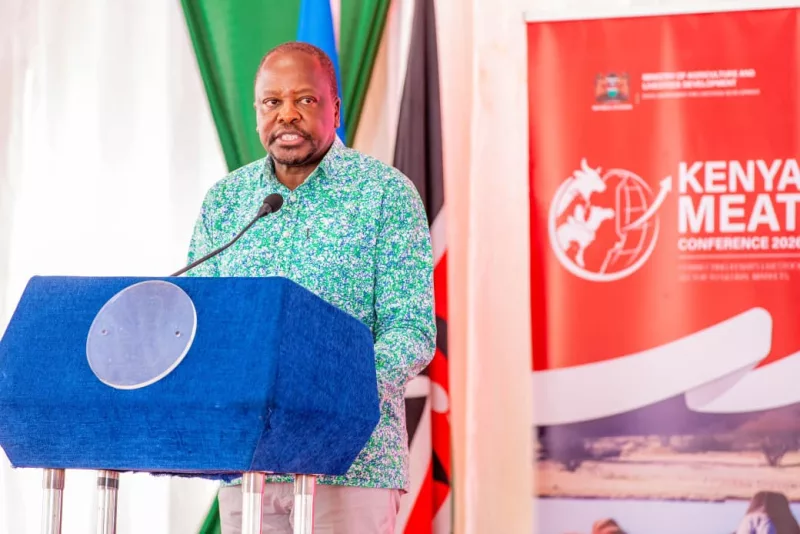
Agriculture Cabinet Secretary Mutahi Kagwe has warned that Kenya risks losing access to lucrative international meat mar kets unless it tackles the growing threat of antimicrobial resistance (AMR) in the livestock sector.
Kagwe said the misuse of veterinary medicines has evolved from a livestock management issue into a major public health, food security and economic challenge.
He cautioned that importing countries are increasingly demanding proof that meat products are free from harmful antimicrobial residues and produced under strict veterinary standards.
"If left unchecked, antimicrobial resistance threatens not only human health but also Kenya's livestock exports," Kagwe said on Wednesday, July 8, during the opening of the Kenya Meat Conference 2026 in Nyeri.
He warned that failure to comply with international food safety standards could undo years of negotiations to secure export markets.
"A single failure can close markets, destroy years of negotiations and damage the reputation of an entire country," he said.
The CS said responsible use of veterinary medicines has become a prerequisite for international trade rather than just a good farming practice.
"Responsible use of veterinary medicines is becoming a passport to international markets," he said.
Kagwe announced that the government is strengthening the Kenya Veterinary Board and the Veterinary Medicines Directorate to tighten regulation of veterinary drugs and ensure they are administered only by licensed professionals.
He cited global estimates showing antimicrobial resistance is linked to about 5.5 million deaths annually, adding that Kenya remains among countries significantly affected by AMR-related deaths.
The CS said the government is implementing sweeping reforms aimed at positioning Kenya as one of Africa's leading exporters of premium meat products under the Bottom-Up Economic Transformation Agenda.
Among the targets is increasing livestock's contribution to the country's Gross Domestic Product from the current 12 per cent to 20 per cent while raising annual meat production from 527,200 metric tonnes recorded in 2022 to nearly 990,000 metric tonnes by 2028.
Kagwe noted that buyers in international markets are increasingly demanding traceability, food safety, disease-free production systems and consistency throughout the livestock value chain.
"They purchase trust. That trust must now become Kenya's greatest export," he said.
To meet these standards, the government is expanding the National Livestock Vaccination Programme and investing in the Kenya Veterinary Vaccines Production Institute (KEVEVAPI) to increase annual vaccine production from about 45 million doses to more than 70 million.
The ministry is also rolling out the Livestock Identification and Traceability System (LITS) and the Animal Identification and Traceability System (ANITRAC), which will allow every animal to be tracked from the farm to the market.
"The modern consumer wants to know where the animal was born, where it grazed, which veterinary officer treated it, which medicines it received and which laboratory certified it. That level of transparency is becoming the global standard," Kagwe said.
The CS also renewed the government's crackdown on illegal donkey slaughter, describing the trade as a threat to food safety and Kenya's export ambitions.
He said despite the 2020 ban on commercial donkey slaughter, intelligence reports indicate that more than 700 donkeys are illegally slaughtered every month, with some of the meat allegedly finding its way into the market disguised as beef.
"This is no longer merely an issue of animal welfare. It is a food safety emergency, economic sabotage and an attack on Kenya's international reputation," Kagwe said.
He directed ministry officials to prepare stricter regulatory measures targeting illegal slaughter networks, livestock theft and meat adulteration.
Kagwe also called for greater investment in modern abattoirs, value addition and livestock financing to enable Kenya to compete effectively in regional and global meat markets.
The two-day conference has brought together government officials, county leaders, researchers, development partners and private sector players to discuss strategies for expanding Kenya's livestock industry and boosting meat exports