
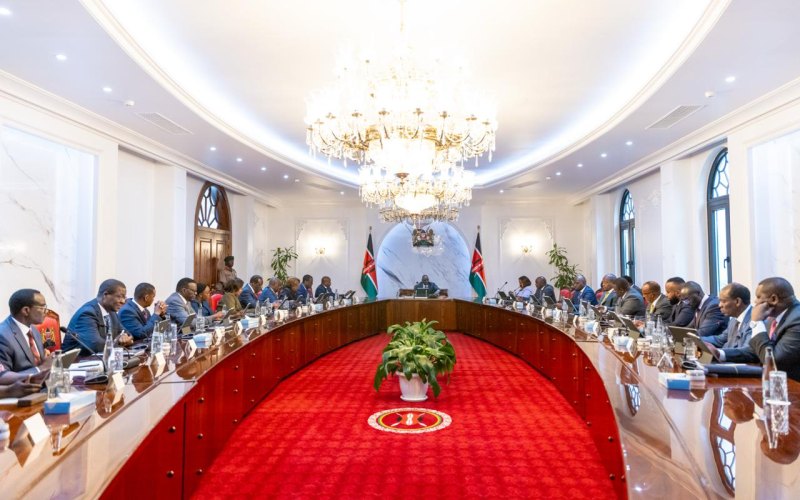
 Cabinet meeting at State House Nairobi on June 30, 2026./PCS
The government has moved to bolster Kenya's preparedness for the forecast moderate-to-strong El Niño rains expected later this year by appointing Deputy President Kithure Kindiki to lead a special Cabinet committee tasked with coordinating the national response.
The decision was made during a Cabinet meeting chaired by the President at State House, Nairobi, Tueasday where ministers approved the formation of an Ad Hoc Cabinet Committee on El Niño Preparedness and Response.
The committee has been directed to immediately activate a National El Niño Contingency Plan to minimise the impact of climate-related disasters across the country.
The contingency plan includes flood mitigation measures, evacuation and shelter arrangements, clearance of drainage systems, reinforcement of vulnerable roads and bridges, pre-positioning of emergency equipment and medical supplies, farmer advisories, and the establishment of a contingency fund to support relief, recovery and rehabilitation.
The government said the measures are aimed at strengthening national preparedness and ensuring a coordinated response ahead of the anticipated El Niño season.
Kenya is among 22 countries around the world that could be badly affected by a powerful El Niño that is developing and is expected to grow stronger in the coming months.
A new report by the Food and Agriculture Organization (FAO) and the World Food Programme (WFP) warns that millions of people could face threats to their food supplies and livelihoods unless governments and aid agencies act early.
The report says Kenya is among countries facing a high risk of climate-related shocks linked to El Niño between late 2026 and early 2027.
"An El Nino is forming, and millions of food-insecure people are in its path. Strong El Nino conditions are developing, threatening food security, agriculture and livelihoods across multiple regions into 2027," the report says.
"This El Nino is expected to bring significantly drier conditions to Southern Africa, Central America, parts of Asia and the Pacific, and Eastern Africa, while increasing the likelihood of floods and storms in the Horn of Africa and parts of Asia."
Kenya appears on a list of priority countries identified by FAO and WFP for urgent support and preparedness efforts before the worst effects are felt.
The agencies selected the countries based on historical El Nino weather patterns, climate forecasts, food insecurity levels, agricultural calendars and their readiness to respond.
The report says Kenya is among high-risk countries where the two UN agencies are "strengthening readiness efforts and supporting the development or refinement of anticipatory action plans considering forecast El Nino risks."
The agencies are asking donors to provide $202 million (Sh26 billion) to help vulnerable communities prepare before disasters strike. They say acting early can save lives, protect crops and reduce future humanitarian costs.
"For the first time, the Food and Agriculture Organization of the United Nations (FAO) and the World Food Programme (WFP) are issuing a joint, forward-looking appeal for anticipatory action at scale," the report says.
"The two agencies are positioned to immediately support 1.2 million people at risk from the predicted El Nino impacts. An additional USD 167 million (Sh21.6 billion) would extend anticipatory assistance to 7.6 million more."
For Kenya and other countries in Eastern Africa, the report warns that the biggest threat is likely to be unusually heavy rainfall and flooding.
It notes that El Nino affects different parts of Eastern Africa in different ways. While some areas may experience reduced rainfall, countries in the Horn of Africa, including Kenya, face a greater risk of floods.
"By contrast, between October and December, in the bimodal areas of the Horn of Africa, including Somalia, Kenya, Uganda and eastern Ethiopia, El Nino is linked to an increased risk of above-average rainfall and flooding," the report says.
"Global models already indicate a high probability of wetter-than-normal conditions during this season."
Flooding could damage farms, destroy infrastructure, spread livestock diseases and force families to leave their homes.
Among the key risks identified for Eastern Africa are "crop losses and damage to agricultural infrastructure", "livestock disease outbreaks, reduced milk production and animal losses", and "population displacement and disruption of livelihoods."
The agencies say countries should begin preparations immediately because there is still time to reduce the impact of the expected weather shocks.
Recommended actions include sending early warnings to communities, providing cash support to vulnerable households, distributing seeds and farm inputs, improving water storage, vaccinating livestock and putting flood protection measures in place.
![[PHOTOS] The new Ngong –Naivasha Road viaduct](https://cdn.radioafrica.digital/image/2026/06/64d4f771-4432-4aee-ba3c-2f304c4436ec.jpg)