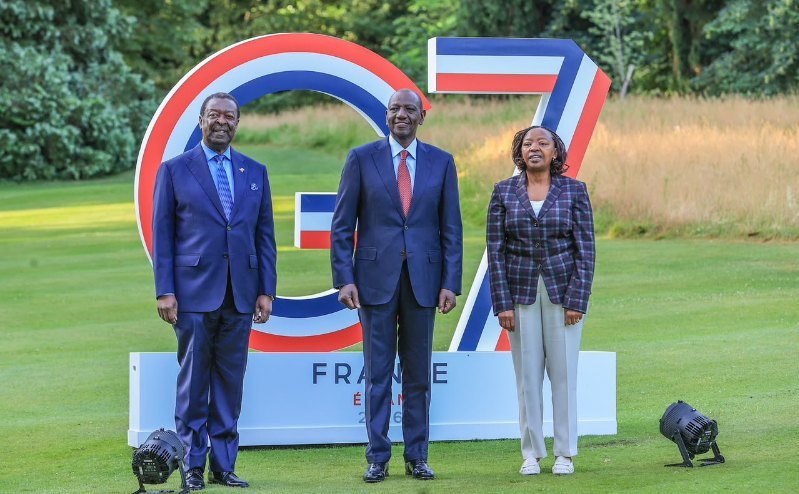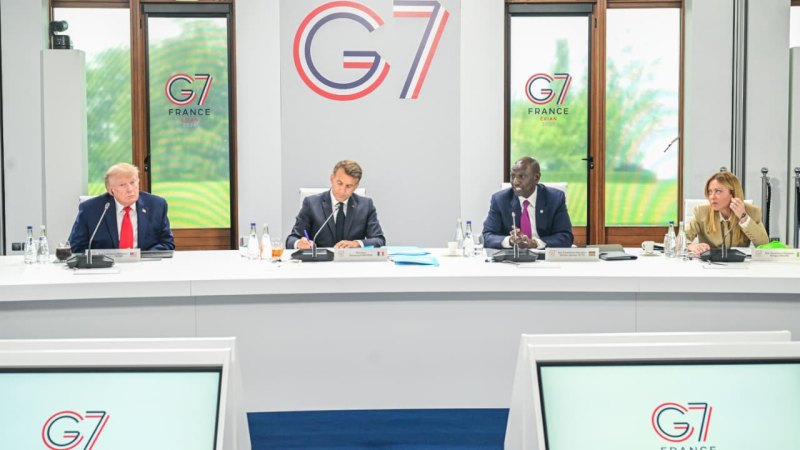
President William Ruto’s long-standing campaign for reforms to the international financial architecture received a major boost on Tuesday after G7 leaders endorsed calls for a more efficient, equitable and development-focused global financing system.
In a declaration on mutually beneficial international partnerships, the G7 leaders, alongside partner countries Kenya and South Korea, acknowledged that the current development finance architecture requires significant reforms to address modern challenges, including rising debt burdens, limited access to affordable capital and growing development financing needs.
The declaration mirrors several proposals that Ruto has consistently championed on global platforms, including fairer access to concessional financing, reforms to debt restructuring mechanisms, increased private sector investment and changes to the way risk is assessed in developing economies.
The President has repeatedly argued that the existing financial system unfairly disadvantages African countries by imposing disproportionately high borrowing costs despite the continent’s vast economic potential.
At the G7 Summit in France, leaders committed to reforming development cooperation systems and creating partnerships that support country ownership, economic sovereignty and resilience while strategically deploying concessional resources where they are most needed.
"We are united in reforming the development cooperation system and shaping mutually beneficial partnerships that take into account our strategic interests and those of our partners," the declaration states.
The leaders further acknowledged shortcomings in the current system, noting that "traditional development policies have achieved important results" but have "at times had limited impact in reducing financial dependency on external assistance, strengthening country ownership and creating pro-growth incentives."
They also observed that "the development architecture has become overly complex, resulting in a suboptimal use of resources."
A key element of the declaration is the recognition that public resources alone are insufficient to meet global development needs and that greater efforts must be made to mobilise private capital through guarantees, blended finance and risk-sharing instruments.
"Public resources continue to play a strategic role, yet they are insufficient alone to meet global development needs," the leaders said, adding that there is a need to "catalyse structured reforms to rationalise the development architecture and ensure its efficiency and impact."
This aligns closely with proposals advanced by Ruto and other African leaders during the Africa Forward Summit, where leaders argued that Africa’s challenge is not a lack of capital but a flawed risk architecture that inflates borrowing costs and discourages investment.
The G7 also pledged support for strengthening institutions that help de-risk investments, including the African Trade and Investment Development Insurance.
In a significant endorsement of Africa’s development agenda, the leaders said they would seek to "support more effective mobilisation of private capital to finance long-term development and impact at scale."
They added that development finance institutions and multilateral development banks, including the International Monetary Fund and the World Bank, should promote "risk-sharing instruments, guarantees, blended finance, co-financing mechanisms, market instruments, and address exchange rate risk."
Another significant win for Kenya and other developing countries is the commitment to address escalating debt vulnerabilities and improve debt restructuring mechanisms.
"We will enhance efforts to address escalating global debt vulnerabilities that threaten economic stability and constrain fiscal space for essential public service interventions," the declaration states.
The leaders also called for faster and more predictable debt treatment processes, saying they would promote strengthening implementation of the G20 Common Framework "to ensure debt treatments are delivered in a predictable, timely, orderly and coordinated manner."
Ruto has consistently maintained that the global debt system needs reform to ensure countries are not trapped by expensive financing and debt-servicing costs that crowd out investments in infrastructure, health, education and climate action.
The declaration further emphasises strengthening domestic resource mobilisation, improving tax administration and helping countries attract long-term investment while reducing dependence on external assistance.
Leaders said they aim to "support our partners' ability to self-finance and reinforce partner countries' ownership, accountability, long-term economic sovereignty and resilience while respecting their development priorities."
The declaration also places emphasis on infrastructure, supply chains and industrialisation, areas Kenya has repeatedly highlighted as essential to Africa’s transformation.
"We will promote supply chain resilience and diversification, and resilient transportation, energy and digital infrastructures," the leaders said, while also recognising "the importance of reliable critical minerals value chains for shared prosperity."
For Kenya and many African countries, the declaration signals growing international recognition that the global financial architecture requires reform to better reflect modern development realities.
While the commitments will require further negotiations and implementation through institutions such as the IMF, World Bank and G20, the declaration marks one of the strongest endorsements yet of reforms that Ruto and other African leaders have been advocating for in recent years.