

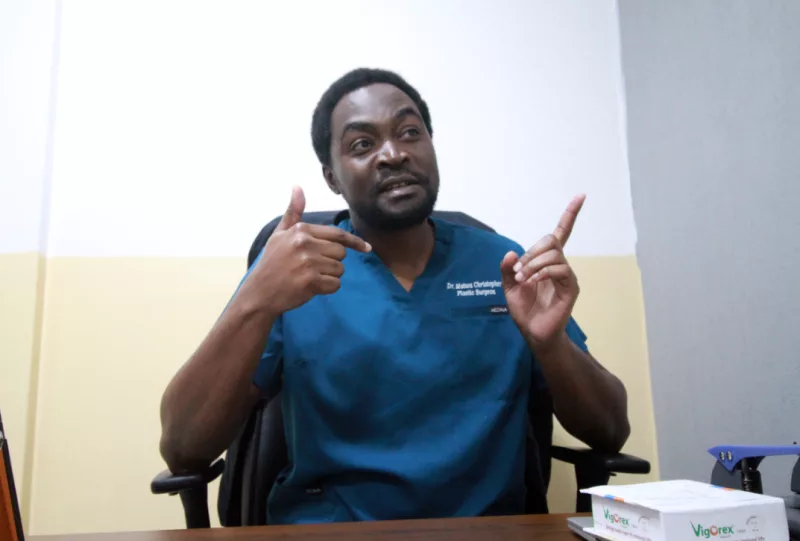
 Plastic and reconstructive surgeon Dr Christopher Matwa speaks during an interview with the Star/ENOS TECHE
Plastic surgery is becoming increasingly accepted in Kenya, with a growing number of professionals seeking cosmetic procedures as part of their personal and career investment, according to plastic and reconstructive surgeon Dr Christopher Matwa.
Speaking in an interview with The Star, Matwa said the stigma that once surrounded aesthetic surgery is gradually fading as more Kenyans openly discuss their experiences and motivations.
He says he is seeing a sharp rise in the number of influencers walking into his clinic seeking procedures that align with the demands of their careers.
"Many influencers now view plastic surgery as an investment in their brand because of the nature of what they do," he said, noting that most of these clients are between the ages of 30 and 50.
Women account for the majority of his patients, with Matwa estimating that about 95 per cent seek post-delivery procedures to restore their bodies after childbirth. Others, he says, undergo cosmetic surgery because of the image expectations associated with their professions.
He believes Kenya is following a global trend where cosmetic surgery is increasingly viewed as a normal healthcare choice rather than a taboo subject.
"In Brazil, you will find parents paying for a cosmetic procedure for their children as a birthday gift when they become adults," he said, citing the South American country as an example of how widely accepted aesthetic surgery has become.
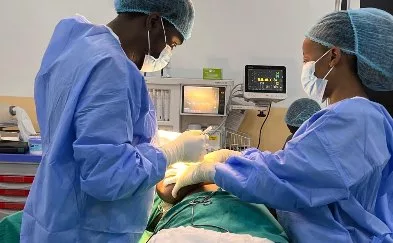 Plastic surgery procedure at Truffel Healthcare in Nairobi's Kilimani area/HANDOUT
Matwa argues that public perception of the risks associated with plastic surgery does not always reflect reality.
"The risks are very minimal for these procedures. If you look at the records, plastic surgery is among the least litigated procedures, with about 0.4 per cent of complaints," he said.
He contrasted this with gynaecological procedures, which he said account for significantly more complications and legal complaints despite many patients undergoing them without extensively questioning the associated risks.
"The chances of complications in plastic surgery are very low," he said.
However, Matwa noted that patient expectations can sometimes influence how the outcome of a procedure is perceived.
"Sometimes the success of a plastic surgery procedure depends on what the patient wants to achieve. If someone undergoes surgery hoping to find love and that does not happen, they may consider the procedure unsuccessful even if it was technically successful," he said.
He emphasised that surgery is only one part of the process.
"Surgery is only 30 per cent of the work. The journey begins when you wake up after the operation," he said, referring to the importance of recovery, follow-up care and adherence to medical advice.
Matwa, who runs Truffel Healthcare in Nairobi's Kilimani area, said breast reduction, liposuction and tummy tucks are the most common procedures he performs.
Breast reduction alone accounts for about half of all surgeries at his practice.
He explained that many women seek breast reduction not for cosmetic reasons alone but to address medical concerns.
"When breasts are excessively heavy, they can cause neck pain, back pain, shoulder notching and even problems with hygiene," he said.
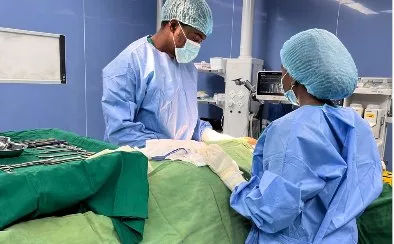 Plastic surgery procedure at Truffel Healthcare in Nairobi's Kilimani area/HANDOUT
Outside his Nairobi practice, Matwa lectures at Kenya Methodist University in Meru. He opened Truffel Healthcare in 2024 while continuing to balance clinical practice with teaching.
Originally from Kisii County, Matwa attended Lenana School before joining the University of Nairobi, where he studied Medical Physiology and later earned a Bachelor of Medicine and Bachelor of Surgery degree.
After graduation, he worked in hospitals in Kakamega and Kocholia in western Kenya for two years before resigning from public service. He later returned to the University of Nairobi to pursue a Master's degree in Plastic, Reconstructive and Aesthetic Surgery.
Matwa said he decided early in his career that he would not remain employed in the public sector, arguing that devolution exposed healthcare facilities to numerous operational challenges.
"Hospitals lack so much that doctors just have to improvise," he said.
He believes private healthcare settings often provide better conditions for delivering quality medical care.
Now seven years into specialist practice in Nairobi, Matwa
says the increasing acceptance of plastic surgery reflects changing attitudes
among Kenyans, particularly those whose careers place a premium on appearance,
confidence and public image.






![[PHOTOS] Elderly brave cold to vote in Ol Kalou](https://cdn.radioafrica.digital/image/2026/07/d2345b9e-578f-45ff-9bb0-d7819671c165.webp)


![[PHOTOS] Ol Kalou residents turn out in large numbers to vote](https://cdn.radioafrica.digital/image/2026/07/fe42d51c-7f79-466e-94e8-59561f77bbe7.webp)