

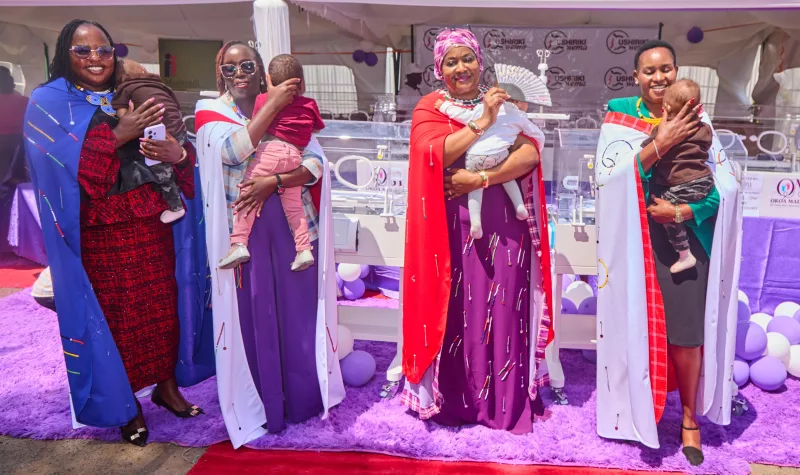
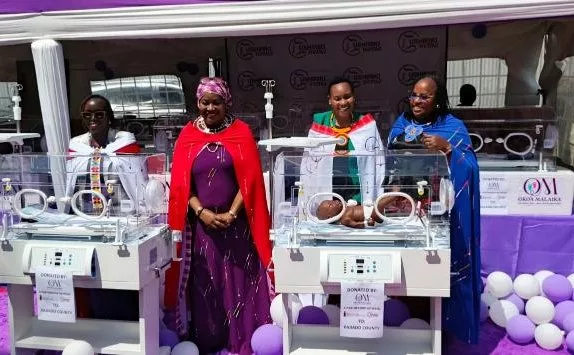
 Ushiriki Wema Foundation Patron Tessie Musalia (2nd right) hands over the Okoa Malaika program neonatal incubators to Narok, Kajiado, Kericho, and Bomet counties on Thursday July 2, 2026 at Narok County Referral Hospital. With her are county first ladies Seline Barchok (Bomet) left, Betty Mutai (Kericho), and Dr Agnes Ntutu (Narok)/HANDOUT
Efforts to improve newborn survival in Kenya received a major boost after the Ushiriki Wema Foundation handed over neonatal incubators to hospitals in Narok, Kajiado, Kericho and Bomet counties.
The donations were made under Ushiriki Wema’s Okoa Malaika programme, an initiative aimed at reducing deaths among premature and critically ill infants.
Addressing the gathering, the Foundation's Patron, Tessie Musalia Mudavadi, described premature birth as one of Kenya's biggest maternal and child health challenges saying every child deserves a healthy start to life.
“Okoa Malaika programme is restoring hope to families by equipping hospitals with life-saving neonatal equipment and strengthening the capacity of healthcare workers to care for vulnerable newborns,” she noted.
Narok County First Lady Agnes Ntutu welcomed the partnership between the county government and the Ushiriki Wema Foundation, noting that increased investment in maternal and newborn healthcare is key to improving child survival and expanding access to quality healthcare services.
Okoa Malaika Brand Ambassador, Njoki Mambo, said the initiative represents hope for mothers and families across the country.
Mambo added that no child should lose the chance to live because a hospital lacks the equipment needed to provide specialised care.
The Foundation said the programme continues to expand its reach to public hospitals across the country as part of efforts to strengthen maternal and newborn healthcare and give every Kenyan child an equal chance at life.
Kenya continues to grapple with a high burden of newborn deaths, with premature birth and complications arising during delivery remaining among the leading causes of infant mortality.
Health experts say babies born too early or with low birth weight often require specialised care, including incubators, respiratory support and close monitoring, particularly during the first few weeks of life.
While the country has made progress in expanding maternal and newborn healthcare services, many public hospitals, especially in rural and lower-level facilities, continue to face shortages of neonatal equipment such as incubators, Continuous Positive Airway Pressure (CPAP) machines and radiant warmers.
In some hospitals, a limited number of incubators means two or more babies may have to share a single unit, increasing the risk of infections and compromising the quality of care.
The shortage of neonatal equipment has contributed to preventable deaths among premature and critically ill infants, with overwhelmed newborn units often struggling to cope with increasing patient numbers.
Health workers have repeatedly called for greater investment
in neonatal intensive care units (NICUs), more trained neonatal nurses and
paediatric specialists, as well as improved maintenance of medical equipment to
ensure facilities remain functional.


![[PHOTOS] Elderly brave cold to vote in Ol Kalou](https://cdn.radioafrica.digital/image/2026/07/d2345b9e-578f-45ff-9bb0-d7819671c165.webp)

![[PHOTOS] Ol Kalou residents turn out in large numbers to vote](https://cdn.radioafrica.digital/image/2026/07/fe42d51c-7f79-466e-94e8-59561f77bbe7.webp)