

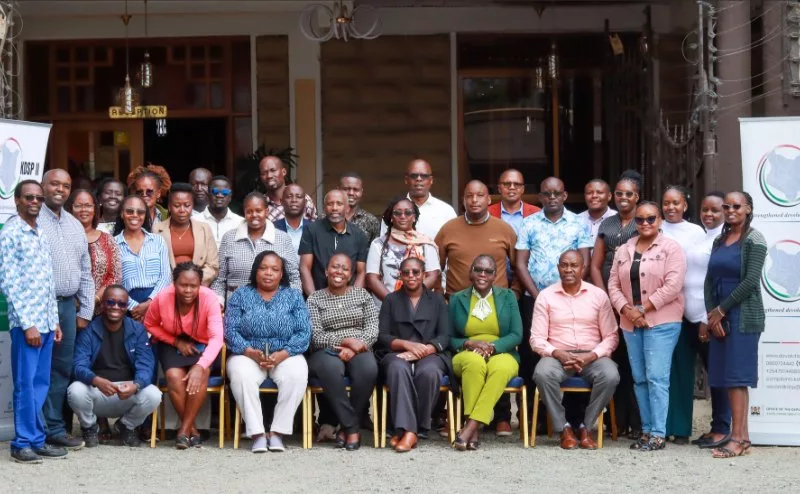
 Some of the representatives from the counties, with the KDSP II National Programme team.
County governments will be required to meet stricter environmental, social, health and safety standards when implementing development projects under a new framework rolled out by the national government.
The State Department for Devolution, through the World Bank-funded Second Kenya Devolution Support Programme (KDSP II), has introduced the Environmental, Social, Health and Safety Risks and Impact Management (ESHRIM) Framework to all 47 counties.
The framework is expected to help counties implement projects that are environmentally sustainable, socially inclusive, safe for workers and surrounding communities, and more accountable to the public.
Speaking during a sensitisation forum attended by representatives from all 47 counties, KDSP II National Programme Coordinator Samuel Nyaga said the new manual establishes a common standard for how counties plan and implement development projects.
“The implementation of infrastructure projects in counties has faced significant challenges related to environmental sustainability, social responsibility, health, and safety compliance,” Nyaga said.
“This gap results in inconsistent approaches to environmental management, potential health and safety hazards, and socio-economic impacts that subsequently undermine sustainable development efforts in the 47 Counties.”
He said the framework is intended to move counties beyond simply understanding safeguard requirements to applying them throughout the life cycle of development projects.
According to Nyaga, the manual will help counties identify, prevent and manage environmental and social risks from project planning through implementation and completion.
He said it also seeks to strengthen existing national and county systems, improve institutional capacity, promote accountability, encourage stakeholder participation and improve service delivery through performance-based approaches.
“Under the new framework, counties must align their infrastructure projects with national and international Environmental, Social, Health, and Safety standards,” Nyaga said.
Officials said the framework brings together environmental protection, workplace safety and social safeguards into a single implementation guide that counties will be expected to follow.
Social Safeguards Specialist Muthoni Kang'ara said the manual integrates health, safety, social and environmental protections into county operations instead of treating them as separate requirements.
“The manual gives counties clear steps to protect workers, engage all project stakeholders including vulnerable and marginalized groups and enhance accountability in projects. It also puts in place measures to prevent sexual abuse and harassment,” Kang'ara said.
She added that the framework ensures social safeguards “are not treated as an afterthought,” but become part of project planning, design and implementation from the outset.
The government also wants counties to improve how they receive and resolve complaints from communities affected by development projects.
Grievance Redress Mechanism Specialist Jonathan Mbului said accessible and trusted complaint-handling systems are essential for improving public confidence.
“Counties need fair and trustworthy systems to handle community complaints and build public trust. These systems must make it easy for citizens to report issues, while ensuring the issues raised by citizens are fixed quickly and kept confidential.”
“Counties can achieve this by strengthening grievance committees, digital tracking and referral pathways for sensitive cases,” Mbului said.
Environmental Safeguards Specialist Belinda Nyakinya said the manual requires counties to integrate environmental protection measures into projects from the earliest planning stages.
“Counties can now protect the environment and keep workers safe at every step of a project—from the first plan to the final stage,” she said.
“This includes checking how projects affect the environment, sorting projects by their threat to the community, planning ways to protect the public, keeping the environment clean, dealing with garbage and waste, and making sure contractors follow safety rules.”
The framework also places greater emphasis on occupational safety, with counties expected to identify workplace hazards before and during project implementation.
Occupational Safety and Health Specialist Jilly Mureri Morabu said counties will now be required to conduct risk assessments and include occupational safety and health requirements in tender documents and Bills of Quantities before projects begin.
“Safety of workers must be factored in throughout the project lifecycle. Strengthening the culture of safety and compliance is important to preventing workplace injuries and ensuring safe project delivery,” Morabu said.
The ESHRIM framework was developed through a multi-agency partnership involving the State Department for Devolution, the National Environment Management Authority, the Directorate of Occupational Safety and Health Services, the State Department for Social Protection, the Commission on Administrative Justice, the Kenya School of Government, the State Department for Gender, county governments and the World Bank.





![[PHOTOS] Elderly brave cold to vote in Ol Kalou](https://cdn.radioafrica.digital/image/2026/07/d2345b9e-578f-45ff-9bb0-d7819671c165.webp)


![[PHOTOS] Ol Kalou residents turn out in large numbers to vote](https://cdn.radioafrica.digital/image/2026/07/fe42d51c-7f79-466e-94e8-59561f77bbe7.webp)