Nassir disputes claims of medicine shortage at Coast General Hospital
He said of the 249 facilities, the county only manages 52 (about 30 per cent) which are public facilities.
by BRIAN OTIENO
Audio By Vocalize
Mombasa governor Abdulswamad Nassir at CGTRH’s new reception on Tuesday / BRIAN OTIENO
Mombasa governor Abdulswamad Nassir [beige shirt], Bulkstream Limited and Jaffer Foundation’s Solomon Ondego [white shirt] and CGTRH CEO Saumu Wayua [partly hidden] at CGTRH on Tuesday / BRIAN OTIENO
Mombasa Governor Abdulswamad Nassir has disputed claims that
patients at the Coast General Teaching and Referral Hospital (CGTRH) are unable
to access drugs.
The governor said Health Cabinet Secretary Aden Duale relied
on incomplete data.
Nassir said Duale erred when he stated that less than 45 per
cent of patients treated at the facility receive medication.
Duale said a system check by the Ministry of Health showed
that many patients visiting CGTRH did not access drugs.
He spoke on June 24 during the 46th Pharmaceutical Society
of Kenya Annual Scientific Conference in Mombasa.
"In Mombasa county, during that period, 235,564 unique
patients were seen. Only 54,364 received drugs, representing a dispensing rate
of 44.75 per cent," Duale said.
"What happened to the rest? About 56 per cent. Is that
not a cause for concern?"
However, during the commissioning of the CGTRH Frontage
Redevelopment Project on Tuesday, Nassir said the figures used by the CS
covered data from 249 health facilities in the county, including both public
and private institutions.
He said the county manages only 52 of those facilities, all
of which are public health institutions.
"Our actual prescription fill rate is not as high as it
should be, but we record more than 90 per cent, about 92 per cent to be
precise," Nassir said.
The governor announced that CGTRH will go fully digital from
September to improve efficiency, curbing drug theft, reducing delays and
addressing misconduct among health workers.
He said the system would allow patients to know how long
they are expected to wait and enable the county to monitor services within the
hospital.
"We don't want patients to visit our public hospitals
because they have no other option. We want them to come because they want
quality services," Nassir said.
He said his administration was working to address challenges
facing the referral hospital, including high electricity costs and the large
number of patients seeking treatment there.
Nassir said the digitisation contract had already been
awarded and implementation had begun.
"This will start with the CGTRH. It will be such that
when one arrives, they will know exactly how long they need to wait, and all
the activities will be monitored," he said.
The system will track patient waiting times and consultation
periods while reducing paperwork.
It will also enable laboratory results to be transmitted
digitally to prevent interference by brokers and conmen.
"When this digitisation comes, we will be having a red
alert that in some hospital, patients are not being taken good care of. The
nurse on duty will then have to answer," Nassir said.
"The doctor will then explain to us why they did not
see a patient."
The governor said cartels had taken advantage of CGTRH
operations but added that reforms were gradually addressing the problem.
"We need answers. Why would a patient who comes fourth
in line get their results first, bypassing those who came first, second and
third in line?" he asked.
Nassir said all CGTRH staff would be required to wear
standard uniforms within 30 days to make them easily identifiable and reduce
cases of impersonation.
He said the uniforms would have unique tags and digital
identification PINs linked to individual staff members.
"Everyone, from the CEO to the sweeper, will have to be
in uniform. If you are not in uniform, we will consider you an imposter,"
he said.
The governor said more hospitals would be built across the
county to reduce pressure on CGTRH, while solar panels would be installed to
help cut electricity costs.



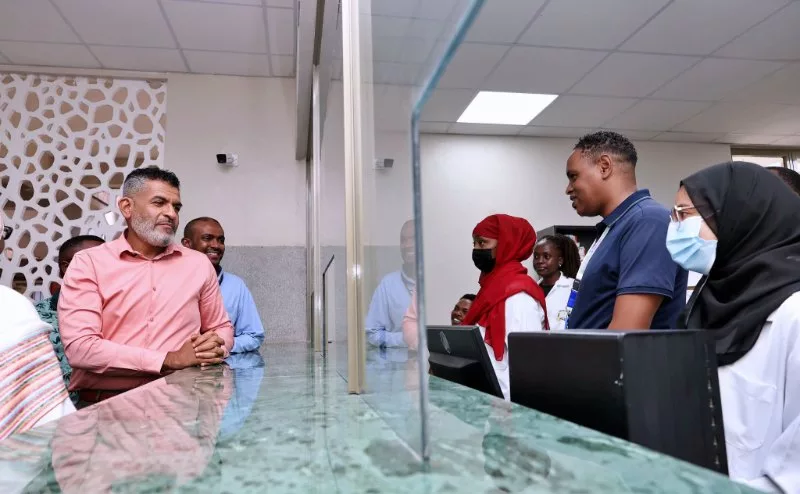 Mombasa governor Abdulswamad Nassir at CGTRH’s new reception on Tuesday / BRIAN OTIENO
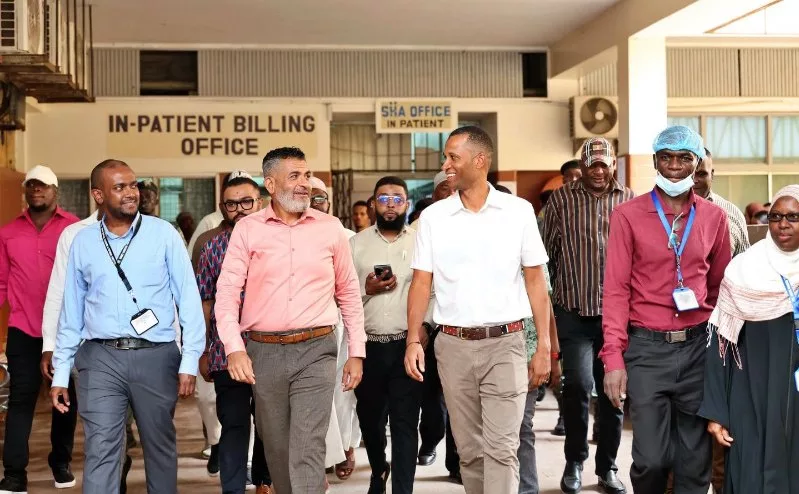 Mombasa governor Abdulswamad Nassir [beige shirt], Bulkstream Limited and Jaffer Foundation’s Solomon Ondego [white shirt] and CGTRH CEO Saumu Wayua [partly hidden] at CGTRH on Tuesday / BRIAN OTIENO
![[PHOTOS] Elderly brave cold to vote in Ol Kalou](https://cdn.radioafrica.digital/image/2026/07/d2345b9e-578f-45ff-9bb0-d7819671c165.webp)


![[PHOTOS] Ol Kalou residents turn out in large numbers to vote](https://cdn.radioafrica.digital/image/2026/07/fe42d51c-7f79-466e-94e8-59561f77bbe7.webp)