

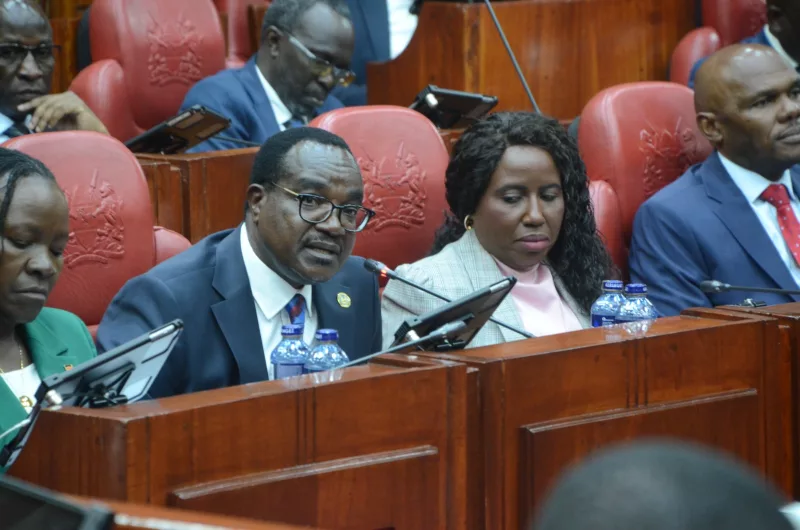
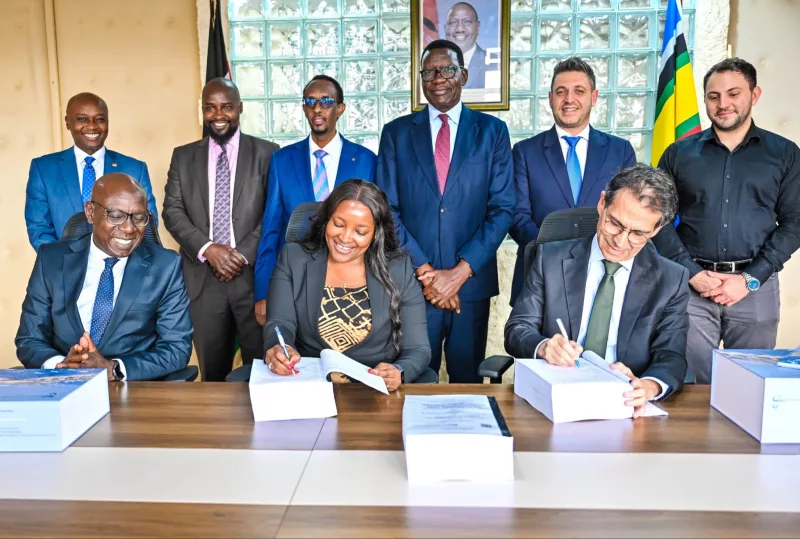
 Education Cabinet Secretary Julius Migos Ogamba and Principal Secretary (PS) for the State Department for Higher Education Beatrice Muganda Inyangala when they appeared before the National Assembly's Public Investments Committee on Governance and Education. PHOTO/ DOUGLAS OKIDDY
Secondary school heads will soon be summoned before Parliament to account for capitation funds as the government moves to tighten oversight of public resources in the education sector.
The National Assembly's Public Investments Committee (PIC) on Governance and Education said it will begin summoning principals of national and other secondary schools after establishing that institutions handling substantial amounts of public funds have largely escaped parliamentary scrutiny.
The committee chair Dick Maungu, said that plans are underway to begin summoning principals of national and other secondary schools handling over 10 million in capitations.
The Luanda lawmaker said that this came after the ministry discovered that institutions handling substantial amounts of public funds have largely escaped parliamentary scrutiny.
"We have since begun receiving reports of high schools and very soon we shall be sampling principals of high schools. We've discovered that a lot of these schools oversee a lot of funds, yet they have not been able to appear before us," Maungu told Education Cabinet Secretary Julius Ogamba during the committee sitting.
He said the committee is developing a framework that will require principals of large secondary schools, particularly national schools, to personally explain how they utilise taxpayers' money.
"You find that sometimes we may examine an institution with about 120 students turning over less than Sh10 million, yet a high school with over 2,000 students receives much larger amounts of public funds but escapes oversight,” added the Luanda MP.
“We shall be beginning very soon with C1 schools and thereafter move to C2 schools and any other institution the committee may find necessary to summon."
This coming after over 1.1 million secondary school students filed to receive capitation funds due to rising enrolment and stagnant budget allocations that have failed to match the growing cost of supporting learners.
While calling for the need for proper accountability and planning, the Ministry of Education however shifted the blame for persistent delays in capitation to schools, technical institutions and universities to chronic underfunding and delayed release of Exchequer funds.
Education Cabinet Secretary Julius Migos Ogamba told Parliament that while the ministry has consistently submitted funding requests on time and immediately remits funds upon receipt from the Treasury, the resources allocated to the sector have failed to match rising enrolment and increasing operational costs, leaving institutions burdened by widening deficits and mounting debts.
"Our challenge is not that the Ministry sits on money. The problem is that the resources released by the National Treasury fall far below the actual funding requirements, and when the Exchequer is delayed, institutions inevitably experience cash flow challenges," CS Ogamba told the committee.
The Cabinet Secretary disclosed that annual capitation for TVET institutions has remained at Sh5.2 billion for several years despite a sharp increase in student enrolment.
He said the funding caters for trainees under the previous capitation system as well as scholarships under the student-centred funding model introduced in the 2023/24 financial year but the budget has not kept pace with demand.
According to the ministry, while the approved annual allocation has remained at Sh5.2 billion, actual disbursements have in several years fallen below that amount, creating funding deficits for institutions.
The ministry further revealed that it has so far disbursed Sh7.9 billion in scholarships under the student-centred funding model, benefiting nearly 200,000 trainees but the programme is already grappling with a cumulative funding deficit of approximately Sh14.9 billion.
CS Ogamba maintained that the State Department for TVET submits Exchequer requisitions to the National Treasury in good time and immediately transfers the money to institutions once released.
"The occasional delays in disbursement of capitation and scholarships are largely occasioned by delayed release of Exchequer funds from the National Treasury. Once we receive the money, we release it immediately to institutions," he said.
The CS painted an even bleaker picture for public universities saying the institutions are grappling with structural underfunding that has accumulated over several years.
He revealed that under the student-centred funding model, universities required Sh29.9 billion during the 2025/26 financial year but received only Sh18 billion leaving a funding gap of nearly Sh11.5 billion.
Continuing students under the previous Differentiated Unit Cost (DUC) model required Sh40.4 billion, yet only Sh23 billion was allocated, resulting in another Sh17.4 billion shortfall.
Overall, universities required Sh70.3 billion for scholarships and grants against an approved budget of Sh41.2 billion, leaving a cumulative deficit of Sh28.9 billion.
CS Ogamba insisted that these deficits should not be misconstrued as unremitted government funds.
"The figures represent budgetary gaps arising from inadequate allocations, not undistributed Exchequer funds. Every shilling released to the Universities Fund was disbursed to eligible public universities," he said.
He added that the persistent mismatch between institutional obligations and available resources has fuelled the accumulation of pending bills and weakened universities' ability to meet payroll, pay suppliers and maintain teaching, research and student services.
"The issue is not simply whether funds are eventually released. Universities require adequate and predictable funding to enable them to meet obligations as they fall due," he said.
The CS outlined measures the ministry has adopted to improve financing, including continuous engagement with the National Treasury to secure supplementary allocations, timely submission of Exchequer requisitions, validation of student data to ensure equitable funding, and pursuit of regular and predictable disbursement cycles.
He said the Universities Fund also reconciles student data before allocating resources to eliminate duplicate claims and ensure institutions receive funding based on verified enrolment figures.
CS Ogamba further said the ministry continues to lobby Parliament and the National Treasury for increased allocations, arguing that administrative efficiency alone cannot resolve the financial challenges facing higher education.
"The financial sustainability of universities cannot be secured through prompt disbursement alone where the resources provided remain inadequate. Equally, adequate allocations cannot support institutional planning where the timing of Exchequer releases is unpredictable," he said.
The committee also questioned the ministry over escalating personnel costs in public universities, which have repeatedly been flagged by the Auditor-General for breaching fiscal responsibility principles.
Responding, Mr Ogamba said universities are labour-intensive institutions whose mandates of teaching, research and innovation depend on highly skilled academic and technical staff.
He argued that the wage bill has been inflated by successive Collective Bargaining Agreements (CBAs) whose financial implications have outpaced government funding.
To cushion universities, he said the government released Sh3.8 billion in December 2025 to settle verified arrears arising from the 2017–2021 CBA, with another Sh3.8 billion scheduled for release in the current financial year.
In addition, the Treasury has committed Sh2.73 billion towards implementation of the 2021–2025 CBA, while negotiations for the 2025–2029 CBA will be guided by affordability assessments before financial clauses are concluded.
The ministry also directed universities to align recruitment with approved staff establishments, strengthen workforce planning, eliminate duplication of functions and tighten controls on personnel expenditure.
However, Mr Ogamba cautioned against indiscriminate staff cuts, saying universities must retain sufficient academic and technical capacity to fulfil their statutory mandate.
"The objective is not merely to reduce the wage bill, but to ensure staffing is efficient, affordable and aligned with institutional needs. Sustainable higher education financing requires adequate funding, predictable disbursement and prudent financial management working together," he said.



![[PHOTOS] Elderly brave cold to vote in Ol Kalou](https://cdn.radioafrica.digital/image/2026/07/d2345b9e-578f-45ff-9bb0-d7819671c165.webp)

![[PHOTOS] Ol Kalou residents turn out in large numbers to vote](https://cdn.radioafrica.digital/image/2026/07/fe42d51c-7f79-466e-94e8-59561f77bbe7.webp)